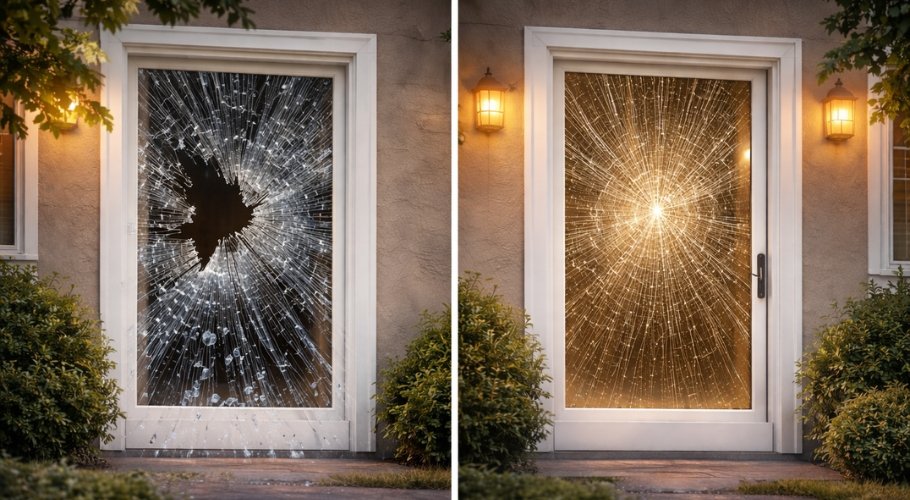
Why Upper Merion Township PA Film Experts Are Recommending Glass Protection First
Walk through any King of Prussia neighborhood — Gulph Mills, Swedeland, the residential streets running off Route 202 — and you will find homes that carry real value and real vulnerability in equal measure. The alarm systems are current. The smart locks are installed. But the one surface that every determined intruder targets first, and every standard security checklist completely ignores, is sitting right there in the frame, transparent and untreated.
Glass is the first point of failure in nearly every residential forced entry. And in Upper Merion Township, where the combination of high-density commercial activity along the King of Prussia corridor and established suburban neighborhoods creates a specific crime profile, that failure point deserves a direct answer.
Film specialists working across Montgomery County are increasingly clear on this: glass protection is not the last layer of home security. It is the first.
What Is It About Upper Merion Township That Makes Glass Vulnerability a Genuine Concern
Upper Merion Township sits 16 miles northwest of Philadelphia in Montgomery County. The township encompasses King of Prussia, Gulph Mills, Swedeland, and Swedesburg — a mix of dense commercial development and established residential neighborhoods ranging from mid-century ranches to newer construction near Valley Forge National Historical Park.
The township’s commercial character matters here. Upper Merion hosts the King of Prussia Mall, one of the largest retail complexes in the United States, along with a major office corridor housing firms in pharmaceuticals, defense, and financial services. This concentration of commercial activity draws significant daily traffic volumes through residential streets and creates an environment where residential properties sit closer to high-activity zones than homeowners in purely suburban townships.
Police incident records from Upper Merion’s Crimewatch activity show consistent retail theft and stolen vehicle reports clustering around the King of Prussia commercial zone — activity that does not stay contained to retail property lines. For residential homeowners in Gulph Mills, along Henderson Road, and in the neighborhoods adjacent to Route 363, the proximity to high-traffic commercial corridors translates into a genuine and specific residential risk context.
Glass is where that risk enters the home.
How Does Upper Merion Township’s Climate Make Glass Performance Even More Critical
Upper Merion Township carries a hot-summer humid continental climate classification — scientifically designated Dfa — with hardiness zone 7a. What this means practically for homeowners is intense solar heat loading from late May through September, significant ultraviolet exposure throughout the warmer months, and a freeze-thaw cycle through winter that stresses older window frames and their associated glazing.
Summer peak temperatures in the King of Prussia area regularly reach the low-to-mid 90s Fahrenheit. South- and west-facing windows in Upper Merion residential properties receive solar irradiance that can push indoor temperatures 10 to 15 degrees above outdoor shaded conditions — straining HVAC systems and degrading interior furnishings simultaneously.
The Schuylkill River, which forms Upper Merion’s natural northern and eastern boundary, contributes elevated ambient humidity throughout summer. That humidity, combined with intense solar gain, creates thermal stress conditions on untreated glazing that accelerate seal degradation in double-pane units and reduce the long-term structural integrity of window framing.
This climate reality matters because glass protection film addresses both the security vulnerability and the thermal performance gap within a single installation — something no alarm system, camera, or lock upgrade can do.
What Does Security Window Film Actually Do to Glass During a Forced Entry Attempt
Standard residential glass — whether single-pane annealed units common in Upper Merion’s older Gulph Mills properties or the double-pane insulated units in newer King of Prussia construction — behaves the same way under sharp impact. It shatters. It evacuates the frame. It creates an unobstructed opening within seconds.
Security window film is a thick polyester laminate applied to the interior glass surface that changes this behavior entirely. When an impacted pane fractures, the film holds the broken fragments together in a cohesive sheet rather than allowing them to fall clear. The opening remains structurally present but physically obstructed — the glass stays in the frame in a cracked but intact configuration.
The practical result is resistance time. Research into residential burglary patterns consistently finds that forced entry attempts extending beyond 60 seconds are abandoned at dramatically higher rates than those completing quickly. The profile of most residential break-ins is opportunistic and heavily time-dependent. Converting a 10-second glass breach into a 60-second or longer resistance event changes the risk calculation for the majority of intrusion attempts entirely.
Security film also blocks 99% or more of ultraviolet radiation as a structural property of the polyester laminate itself — not as an added coating. For Upper Merion homeowners with hardwood floors, upholstered furniture, and window treatments, that UV protection prevents the photochemical fading that accounts for approximately 40% of interior surface degradation over time.
Which Film Specification Is the Right Match for Upper Merion Township Homes
Performance varies significantly by thickness, and selecting the appropriate specification for each location in the home matters both for effectiveness and long-term investment value.
4 mil security film provides basic glass fragment retention post-impact and consistent UV blocking. It is appropriate for upper-floor windows and secondary openings that are not primary entry targets. For Upper Merion properties, 4 mil alone is generally insufficient at primary ground-floor entry points.
8 mil security film is the specification that makes practical sense for most Upper Merion Township residential applications. At this thickness, the laminate provides genuine sustained impact resistance — holding fragments together under repeated blows rather than just a single strike. For the ground-floor windows, sidelights adjacent to front and rear entries, and glass panels in French doors that characterize King of Prussia area residential construction, 8 mil film delivers meaningful protection while remaining optically clear and architecturally invisible once installed. It also carries solar control properties in certain formulations that can reject 50 to 70 percent of total solar energy — a genuine operational benefit given Upper Merion’s summer heat load.
12 mil security film approaches commercial-grade performance and is appropriate for the highest-risk openings in a residential property: large sliding glass rear doors, floor-to-ceiling glazing at ground level, and any oversized glass panels within reach of door hardware. In Upper Merion homes where substantial rear decks and patio access are common, 12 mil at these specific openings provides the most complete glass security available through retrofit film.
Anchored installation adds a structural silicone perimeter seal that mechanically bonds the glass-and-film unit to the window frame itself. Standard film installation holds fragments together but allows the pane to be pushed inward under sustained pressure. An anchored system requires the frame to be defeated as well — substantially raising the time and effort cost of any forced entry attempt. For the most exposed openings in Upper Merion Township properties, anchored installation is the highest-specification approach available.
What Makes Glass Protection a Long-Term Investment Rather Than Just a Security Expense
For Upper Merion Township homeowners evaluating glass protection film against other security investments, the comparison shifts when the full scope of benefits is considered together.
A standard alarm system monitors and alerts. A camera system records and deters. Neither one physically delays or prevents glass breach. Security film is the only residential security upgrade that directly changes how the glass itself performs under attack — passively, continuously, without activation, monitoring fees, or behavioral requirements from the homeowner.
Layered onto that core function is the UV protection benefit that preserves interior furnishings, the solar control performance that reduces summer HVAC demand, and the optically clear installation that requires no visible modification to the home’s exterior appearance or architectural character.
For homeowners in Gulph Mills, King of Prussia, and the residential neighborhoods of Upper Merion Township ready to close the one security gap that most upgrades leave untouched, speaking with a window film specialist who understands the township’s specific property profile and security context is the right starting point. A perimeter assessment identifying the highest-priority glass openings translates the investment directly into the locations where it provides the most measurable impact.
FAQ
Does security window film change how windows look from outside a King of Prussia home?
No — professional-grade security film is fully optically clear and invisible from the exterior.
What film thickness is recommended for ground-floor sidelights in Upper Merion Township?
8 mil is the standard starting specification for primary ground-floor entry-adjacent glass openings.
Can security film handle Upper Merion’s freeze-thaw winters without peeling or failing?
Yes — professional-grade laminates are engineered for mid-Atlantic climate conditions including freeze-thaw cycles.
Does security film also reduce summer heat coming through south-facing windows in King of Prussia?
Yes — certain 8 mil formulations reject 50–70% of total solar energy as a combined performance benefit.
How long does security window film last on a Montgomery County PA residential property?
Most professional laminates carry 10-to-15-year performance warranties under normal installation conditions.