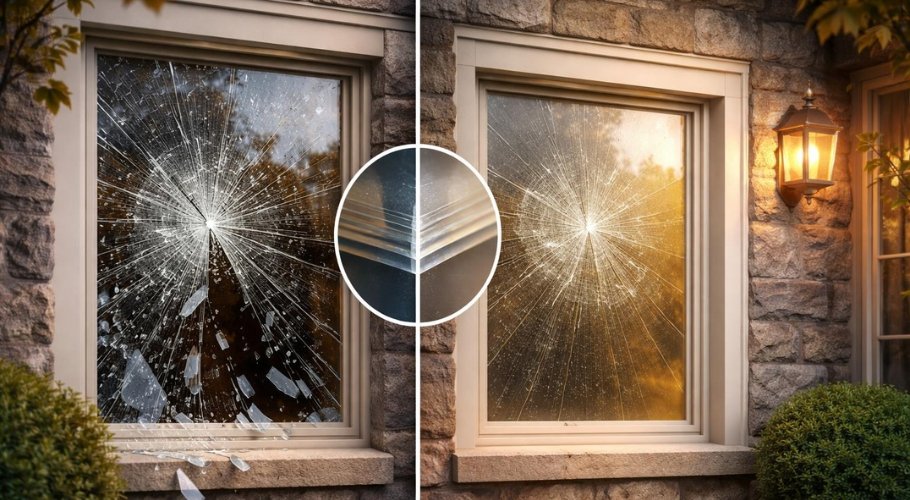
Why Radnor Township PA Residents Are Treating Windows as Their First Security Layer
Most homeowners in Radnor Township have already covered the obvious bases. There’s a monitored alarm system. The deadbolts are solid. Maybe a video doorbell watches the front entry. And yet, the fastest and quietest point of forced entry into almost every home along the Main Line sits completely unprotected — visible from the driveway, present on every floor, and requiring no tools to defeat in under ten seconds.
It’s the glass.
This isn’t a theoretical risk. Standard residential window glass shatters on sharp impact and vacates the frame almost immediately. No alarm triggers before that happens. No lock slows it down. In Radnor Township — where Wayne, Villanova, St. Davids, and Garrett Hill neighborhoods carry extraordinary property values alongside historic and semi-historic architecture — that ten-second vulnerability is one that careful homeowners are starting to close with a single, invisible upgrade.
What Makes Radnor Township Homes More Glass-Vulnerable Than Most People Realize
Radnor Township sits in Delaware County, approximately thirteen miles west of Philadelphia on the prestigious Main Line corridor. The township’s residential fabric spans homes built from the late 1800s through the mid-twentieth century — stone colonials, Tudor estates, Georgian Revivals, and early craftsman properties that define the area’s architectural identity.
That heritage creates a specific security problem. Many of these homes were built with large single-pane original glazing, leaded sidelights, and oversized French doors that reflect the design values of their era. Standard annealed glass — the type found in pre-1970 homes — shatters on impact and clears the frame almost instantly. The entry point opens in seconds, not minutes.
Even newer Radnor properties with standard double-pane insulated units offer no meaningful resistance to forced entry. Those units are engineered for thermal performance, not impact containment. When struck, both panes shatter in rapid sequence. The mechanism is the same — just with two panes instead of one.
How Does Standard Glass Actually Fail During a Break-In Attempt
The physics is straightforward and consistent. When an annealed glass pane receives a sharp impact, it fails in tensile stress. The glass fractures from the point of impact outward, and the individual fragments lose structural cohesion with the frame almost immediately. In practice, this means the broken glass falls away and the opening is cleared.
What this creates is an unobstructed breach that takes seconds to produce and seconds to enter through. The entire forced-entry sequence — strike to interior access — typically completes in under fifteen seconds on untreated glass.
Residential burglary behavior research confirms that speed is the critical variable. Entry attempts taking longer than 60 seconds are abandoned at significantly higher rates than fast ones. The vast majority of residential break-ins are opportunistic and time-sensitive. An intruder who cannot clear the glass quickly will typically move on. The question is whether the glass gives them any reason to stop.
What Role Does Security Window Film Play in Changing Glass Behavior
Security window film is an optically clear polyester laminate applied to the interior surface of existing glass. It does not make glass unbreakable. What it does is fundamentally change what happens after impact.
When a treated pane receives a blow and shatters, the film holds the fragmented glass together within the frame rather than allowing the pieces to fall away. The result is a cracked, weakened, but largely intact pane that remains anchored in the frame under continued pressure. Instead of clearing in seconds, the opening resists — for 60 seconds, 90 seconds, or longer depending on film specification and installation method.
That delay changes the risk calculation entirely for the opportunistic, speed-dependent entry attempts that describe the majority of residential break-ins. The glass becomes a barrier with time cost rather than a surface that disappears on first contact.
This is passive protection. It requires no activation, no subscription, and no behavioral change from the homeowner. Once installed, it functions every hour, every day, without attention.
Which Film Specification Actually Matches the Security Needs of a Radnor Township Home
Not all security films perform equally. Thickness is the primary performance variable, and selecting the right specification for each location in the home matters for both effectiveness and long-term value.
4 mil film provides basic glass fragment retention and blocks 99% of UV radiation as a structural property of the polyester laminate. It is a useful upgrade for upper-floor windows and secondary openings but is generally insufficient on its own for primary entry-point security in a Main Line property.
8 mil film is the specification that makes genuine practical sense for most Radnor Township residential applications. It provides substantial impact resistance — holding glass fragments together under repeated blows — and is appropriate for the ground-floor windows, sidelights adjacent to front and rear entries, and glass French doors that characterize Main Line architecture. It installs clear, preserves the appearance of historic glazing, and carries no visible presence once in place.
12 mil film approaches commercial-grade performance and is the right choice for the highest-risk openings: large sliding glass doors to rear gardens and terraces, floor-to-ceiling ground-level glazing, and any oversized glass panels within reach of door lock hardware. In Radnor Township homes where generous rear gardens and multiple glass access points are standard architectural features, 12 mil at the critical openings provides the most complete glass security available through retrofit film alone.
Anchored installation adds a structural silicone perimeter seal that mechanically bonds the glass-and-film unit to the window frame itself. In standard installation, the film holds fragments together but the pane can still be pushed inward on sustained force. An anchored system requires the frame to be defeated — a substantially more difficult and time-consuming operation that meaningfully raises the barrier for any entry attempt.
What Additional Benefits Come Standard With a Security Film Installation
Security film at 8 mil and 12 mil thickness blocks 99% or more of ultraviolet radiation as a built-in property of the polyester laminate. For Radnor Township homes with hardwood floors, period rugs, upholstered furniture, and artwork near windows, this UV protection slows the fading and photochemical degradation that direct sunlight causes over time. UV radiation accounts for approximately 40% of interior fading damage — a meaningful secondary benefit that adds practical value to every installation.
Some security film specifications also incorporate solar control properties, providing both impact resistance and heat rejection in a single product. For the south- and west-facing windows of Main Line homes that receive intense afternoon sun in the Pennsylvania summer, a security film with solar control layering addresses two vulnerabilities simultaneously without adding installation complexity.
For Radnor Township homeowners who have already addressed the visible security layers and are looking for the next meaningful upgrade, a window film specialist familiar with Main Line residential applications can identify which specifications genuinely match the specific entry-point profile of their property. That assessment — starting with ground-floor sidelights, rear garden doors, and accessible windows — is the practical first step toward treating glass not as a vulnerability, but as the first real line of defense.
FAQ
Does security window film change the exterior appearance of windows in a Radnor Township home?
No — professional-grade security film is optically clear and completely invisible from outside the property.
What film thickness is the right starting point for a Main Line colonial with original sidelights?
8 mil is the practical standard for most ground-floor entry-adjacent glass in residential Main Line properties.
Can security film be removed later without damaging the original glass in a historic home?
Yes — professional films are designed as reversible retrofits, removable without etching or adhesive residue.
How long does security window film typically last on a Delaware County PA property?
Most professional-grade security laminates carry 10-to-15-year performance warranties under normal conditions.
Does security film work the same way on older single-pane glass as it does on modern double-pane units?
Yes — single-pane glass is often the ideal substrate with fewer thermal stress compatibility concerns than double-pane.