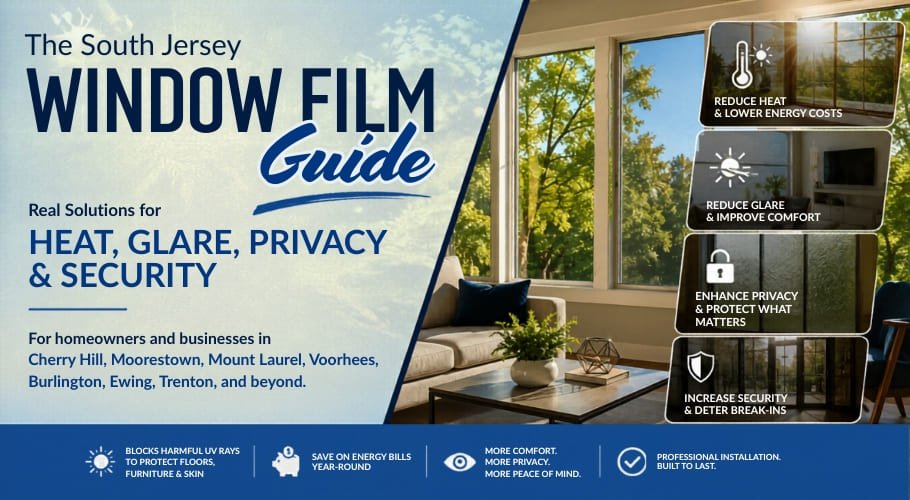
The South Jersey Window Film Guide: Real Solutions for Heat, Glare, Privacy & Security
For homeowners and businesses in Cherry Hill, Moorestown, Mount Laurel, Voorhees, Burlington, Ewing, Trenton, and beyond.
If you’ve lived in South Jersey for more than one summer, you already know the drill. By mid-afternoon, the west side of your house feels like a greenhouse. You’re squinting at your TV. You’re running the AC harder than you’d like. And somewhere in the back of your mind, you’ve started wondering why your hardwood floors look a little different near the windows than they did a few years ago.
That last part is the sneaky one. The heat and glare are annoying — but UV damage is the silent problem. It’s been slowly fading your floors, furniture, curtains, and artwork long before you ever noticed.
More South Jersey homeowners and business owners are dealing with this by installing window film — and honestly, once you understand how much of a difference the right film makes, it’s hard to understand why more people don’t do it sooner.
The catch? Not all film is the same, and not every product works on every building. Get it wrong and you’re looking at bubbling, peeling, or worse — thermal stress on your dual-pane windows. This guide is written specifically for South Jersey properties so you can skip the guesswork.
Why South Jersey Is Different From the Rest
Most window tinting advice online reads like it was written for somewhere in the middle of the country with mild weather and simple single-pane windows. That’s not us.
Here, you’re dealing with real seasonal extremes — hot, humid summers and cold winters that regularly dip below freezing. That constant expansion and contraction is hard on low-quality films. After a few seasons, you start to see it: bubbling edges, a yellowish tint, adhesive that’s given up.
There’s also the dual-pane window issue. A huge portion of South Jersey homes built after the late ’90s have insulated glass units, and applying the wrong film to those can create thermal stress and potentially void your manufacturer warranty. It’s the kind of thing a local installer knows because they’ve seen it happen.
Beyond that, every neighborhood has its own quirks:
- Moorestown and Haddonfield have older, historic homes where a subtle, barely-there film appearance matters.
- Cherry Hill and Burlington storefronts tend to prioritize security and glare reduction above everything else.
- Mount Laurel’s newer homes often have large rear-facing windows that turn back rooms into ovens by afternoon.
- Medical and professional offices in Voorhees frequently want privacy and decorative films for interior glass — conference rooms, exam areas, reception glass.
Local knowledge isn’t a sales pitch. It’s just genuinely useful when you’re trying to get this right.
What Kind of Film Do You Actually Need?
Most people calling about window film fall into one of three situations.
You’re dealing with heat, glare, and fading
This is far and away the most common call we get across South Jersey suburbs.
Your rooms are uncomfortably hot by late afternoon. Your energy bills climb every summer. You’re keeping blinds closed on sunny days just to make the space livable. And you’ve started to notice uneven fading on your floors near the bigger windows.
For most of these situations, solar control window film is the answer — specifically modern ceramic films, which can reject a substantial amount of solar heat while still letting natural light in. Unlike the dark, purple-tinted films from years past, quality ceramic films stay clear, don’t mess with your Wi-Fi or cell signal, and they hold up over time.
They work especially well on large rear-facing windows, sunrooms, home offices, two-story foyers, and any living room with a western exposure. The goal for most homeowners is comfort without making the house feel dim — and ceramic films hit that balance well.
You own a business and security is a concern
This one matters more than a lot of South Jersey business owners realize until something happens nearby.
Standard storefront glass looks solid, but it breaks faster than you’d think during a forced-entry attempt. Security window film won’t stop a determined person, but it holds shattered glass together — which slows entry significantly and creates a real deterrent during smash-and-grab situations.
For retail in Cherry Hill, Burlington, Trenton, and throughout Camden County, that extra delay can matter a lot.
Security film gets installed most often on retail storefronts, office entrances, schools, medical buildings, ground-floor commercial windows, and glass lobby systems. A lot of business owners also combine it with solar control film, so they’re getting both security and employee comfort from one installation.
You want privacy, aesthetics, or something more specialized
Not everything is about heat or security. Sometimes you just want the bathroom window frosted, or you want a conference room that feels more private without losing natural light.
Frosted and gradient films are popular for bathrooms, medical offices, glass partitions, entry doors, and street-facing office glass. They’re clean, modern-looking, and a lot more flexible than most people expect — you can get custom patterns, branding elements, or gradient effects that fade from frosted to clear.
Specialty options also exist for anti-graffiti, anti-microbial surfaces, one-way daytime privacy, and custom branding or logo integration.
What Does It Cost?
Pricing varies based on film type, glass size, how accessible the windows are, and how complex the installation is. As a general guide:
- Residential solar films: roughly $8–$15 per sq. ft.
- Security films: roughly $12–$22 per sq. ft.
- Premium ceramic or decorative films: roughly $15–$30+ per sq. ft.
For homeowners, the most practical approach is often starting with the worst offenders — the windows that make rooms unbearable — rather than tinting every window in the house at once. You get most of the benefit at a fraction of the cost.
For businesses, the priority is usually the highest-risk or highest-exposure glass first, then expanding from there.
One thing worth knowing: the price gap between budget film and quality film isn’t as large as people expect, but the performance gap is enormous. Cheap film can look fine for a year or two, then start discoloring or bubbling by year three. Quality film professionally installed on the right glass is built to last 15–25 years.
Where We Work
Window film needs genuinely vary from neighborhood to neighborhood, which is why local experience matters. We regularly work across:
Cherry Hill · Moorestown · Mount Laurel · Voorhees · Haddonfield · Marlton · Medford · Burlington Township · Ewing Township · Lawrence Township · Trenton · Hamilton · Washington Township · Mullica Hill
Whether it’s a Victorian in Haddonfield, a retail strip in Cherry Hill, or a corporate office in Mount Laurel — every project gets recommendations based on your specific glass, sun exposure, and what you’re actually trying to solve.
Have questions about your specific windows? Reach out and we’ll give you a straight answer.