New Jersey Window Tint Laws 2026: Is Your Car Legal in South Jersey?
2026 New Jersey window tint laws to ensure your vehicle remains legal while driving through South Jersey.
You’re driving through Cherry Hill or pulling into a parking lot in Voorhees, and a police officer waves you over. Not for speeding — for your window tint. It happens more often than most South Jersey drivers realize, and the fines are no joke. If you’ve had your car tinted recently, or you’re thinking about it, understanding exactly where New Jersey law draws the line in 2026 could save you real money and real headaches.
New Jersey has some of the most specific window tinting regulations in the country — and South Jersey’s mix of suburban commuter traffic, shore-bound summer routes, and active law enforcement corridors makes compliance more than just a technicality here.
Understanding VLT: The Number That Determines Everything
Before you can understand New Jersey’s tint laws, you need to understand one term: Visible Light Transmission, or VLT. This is the percentage of light that passes through your window glass after tinting is applied. The higher the VLT percentage, the lighter and more transparent the tint. The lower the number, the darker the film.
Here’s where it gets important: VLT is measured as a combined figure — meaning the factory tint already baked into your car’s glass plus any aftermarket film you add. Many South Jersey drivers assume the percentage printed on a film roll is what the officer’s meter will read. It’s not. If your car’s factory glass already transmits 80% of light and you add a film rated at 50%, your actual combined VLT is closer to 40%. That can put you in violation even if the film itself sounds light.
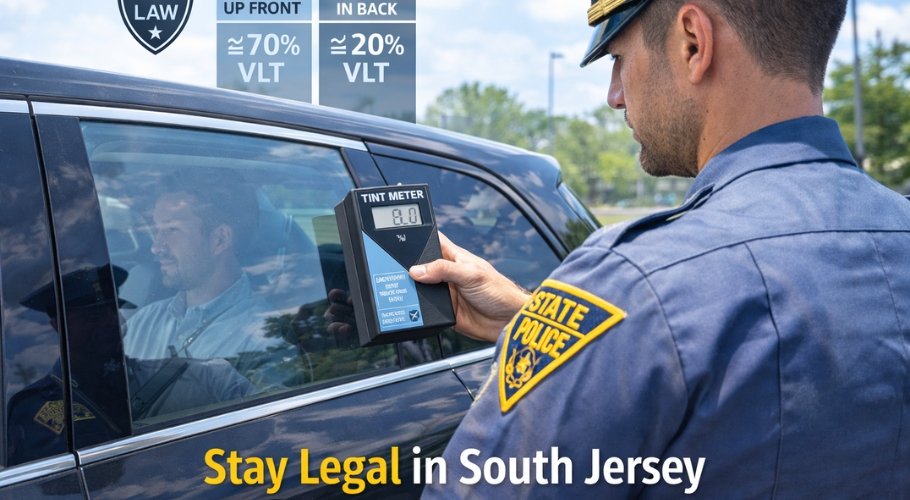
Professional installers use calibrated tint meters after installation to confirm real-world VLT. This is the number that matters during a traffic stop.
New Jersey’s Tint Laws in 2026: Window by Window
New Jersey’s regulations haven’t changed dramatically, but enforcement has tightened across the state — including South Jersey corridors like Route 130, Route 38, and the AC Expressway. Here’s what the law currently requires:
Windshield No aftermarket tint is permitted on the windshield. Some states allow a small strip at the top (called the AS-1 line), but in New Jersey, the front glass must remain completely clear of applied film.
Front Side Windows This is where New Jersey is unusually strict by national standards. No tinting is allowed on front side windows — period. States like Florida and Texas permit front window tint as dark as 25–28% VLT. New Jersey is among only a handful of states that prohibit front side tinting entirely, regardless of how light the film is.
Rear Side Windows Any darkness level is permitted. You can legally run limo-dark tint — even 5% VLT — on your rear side windows in New Jersey.
Rear Window Any darkness level is permitted here as well. However, if you tint your rear window, you are legally required to have dual side mirrors on your vehicle to maintain adequate rear visibility.
Reflectivity No mirrored or metallic-appearance tint is allowed on any window — front or rear. This applies to both sedans and SUVs/vans equally. Tint that creates a reflective, mirror-like surface from the outside is prohibited statewide.
Why South Jersey Drivers Get Caught More Than They Expect
The Shore effect is real. During summer months, South Jersey sees a massive influx of out-of-state vehicles — many from Pennsylvania, Delaware, and New York — where front window tinting laws are different. Some South Jersey residents get their cars tinted at shops just across the border in Pennsylvania, where regulations are less restrictive, and then drive those vehicles daily through Burlington County, Camden County, or along the Atlantic City Expressway.
Officers in this region are accustomed to seeing vehicles with out-of-state tint applied. And unlike some traffic violations, window tint is visually obvious. Enforcement doesn’t require a speed gun or breathalyzer — just a tint meter and a trained eye.
Additionally, vehicles with front side tint often fail New Jersey’s mandatory state inspection. A failed inspection can block registration renewal, adding bureaucratic costs on top of any fines.
The Real Penalty Picture
First-time violations under New Jersey statute 39:3-75.3 can result in fines up to $1,000. Repeat offenders can face penalties up to $5,000. That’s a significant cost for a tint job that might have run a few hundred dollars.
Beyond the fine itself, you may face a mandatory order to remove the tint — which means paying for professional removal on top of everything else. If the vehicle fails inspection as a result, you’ll also be dealing with re-inspection fees and potential registration complications.
It’s worth noting that enforcement intensity can vary by municipality across South Jersey. Some areas are more active than others, but there is no “safe zone” — any officer in any township has the authority and the equipment to check your tint.
Medical Exemptions: What South Jersey Drivers Should Know
New Jersey does allow medical exemptions for drivers with qualifying conditions. Photosensitive disorders — conditions where sunlight exposure causes significant physical harm, such as lupus, certain forms of skin cancer, or polymorphous light eruption — may qualify a driver for an exemption that permits darker front window tinting.
To qualify, you must obtain certification from a licensed physician and apply through the New Jersey Motor Vehicle Commission’s Sunscreening program. The exemption must be renewed every four years. Drivers granted an exemption are required to carry their documentation in the vehicle at all times and present it to law enforcement upon request.
If you believe you may qualify, speak with your physician before getting any tint applied to your front windows. Getting the exemption in place first is always the right sequence.
Premium Film vs. Basic Tint: Why the Difference Matters in South Jersey
South Jersey summers are legitimately punishing. Humidity amplifies the effect of radiant heat, and vehicles sitting in parking lots across Burlington or Camden counties can reach interior temperatures well above 130°F on a clear July afternoon. A lot of South Jersey drivers turn to window film not just for privacy — but for heat relief and UV protection.
Here’s the issue: not all films are created equal, and compliance is not the only metric worth considering.
Basic dyed films are inexpensive and darken the glass visually, but they offer relatively weak performance in blocking infrared heat — the kind that turns your parked car into an oven. They also tend to fade and bubble over time, especially under South Jersey’s seasonal UV intensity.
Higher-performance films — ceramic and nano-ceramic options in particular — are engineered differently. They use advanced particle structures to reject a much higher percentage of solar heat and UV radiation without relying on darkness. A high-quality ceramic film at perfectly legal VLT levels can reject 40–60% of total solar energy, block over 99% of UV rays, and reduce interior temperature significantly — all while remaining fully compliant with New Jersey law.
This matters because it means you don’t have to push into illegal darkness to get meaningful heat and UV protection. A well-specified legal film can deliver real comfort, protect your interior from fading, and keep you on the right side of the law.
Practical Guidance for South Jersey Car Owners
A few straightforward steps will protect you before and after any tinting decision:
Verify film specifications before installation. Ask your installer for the post-installation combined VLT reading, not just the film’s rated percentage. Get it in writing.
Don’t tint your front side windows. No matter how good the film is or how light it looks, aftermarket tint on front side windows is not legal in New Jersey. Full stop.
If you want heat rejection on the front, look at clear films. There are high-performance films with near-invisible clarity that still block significant UV and infrared heat. These are legal options for front glass that many drivers overlook entirely.
Understand the dual mirror requirement. If you apply any tint to your rear window, make sure your vehicle has functional dual side mirrors. This is a legal requirement, not a suggestion.
Consider medical exemption if applicable. If a sun-related medical condition applies to your situation, go through the proper MVC process before applying any non-compliant tint.
To get a full picture of what legally compliant, high-performance film options make sense for your specific vehicle in South Jersey’s climate, consider speaking with a local window film specialist who understands both New Jersey law and the regional demands of this area’s heat, UV exposure, and inspection environment.
The Bottom Line
New Jersey’s tint laws are stricter than most drivers assume, and South Jersey’s enforcement environment means the consequences of non-compliance are real. The front side windows must remain clear. The windshield must remain clear. Rear windows can be as dark as you want — with the mirror requirement in place.
The good news is that legal compliance and meaningful heat and UV protection are not mutually exclusive. The right film, installed by someone who knows New Jersey’s regulations and uses accurate VLT meters, can give South Jersey drivers genuine comfort and protection without a single worry at the inspection lane or during a traffic stop.
Know the law. Know your film. Stay legal.