What Princeton, NJ, Residents Should Know Before Installing Window Film?
Everything homeowners and business owners in Princeton need to understand before making one of the smartest upgrades to their property.
There’s a certain irony about Princeton, NJ. A town celebrated for world-class thinking, historic architecture, and refined living — yet many of its homes and commercial buildings quietly lose energy, comfort, and interior value through their windows every single day. Whether it’s a Victorian on Nassau Street, a contemporary on the outskirts of the Princeton University corridor, or a business along Route 1, the challenge is the same: glass that lets in far more than just light.
If you’re a Princeton resident or business owner thinking about window film, you’re already ahead. But before you make a decision, there are several things worth understanding — about the local climate, your building type, and the film itself.
Why Princeton’s Climate Makes Window Film a Serious Consideration
Princeton sits in Mercer County in central New Jersey, experiencing a true four-season mid-Atlantic climate. That means genuinely cold winters, unpredictable springs, and summers that are consistently hot and humid. July average highs hover around 85°F to 87°F, but the heat index regularly pushes perceived temperatures past 95°F. UV index readings during peak summer months frequently reach 7 to 9 — classified as high to very high by the EPA.
This matters more than most people realize. Standard residential and commercial glass transmits up to 75% of the sun’s total solar energy. That includes visible light, infrared heat, and ultraviolet radiation — three very different components of sunlight with three very different effects on your interior. You see the light. You feel the heat. But the UV rays work silently, degrading flooring, artwork, window treatments, and furniture over months and years.
Princeton’s winters add another dimension. With average January lows in the mid-20s°F, energy loss through glass becomes a heating-season concern as much as a cooling-season one. Quality window film addresses both ends of the calendar.
What Window Film Actually Does — and What It Doesn’t
Before installation, it’s important to set accurate expectations. Window film is not a blackout solution. It does not make your windows opaque. And it does not eliminate natural light — that’s actually one of its core strengths.
What it does is selectively manage the solar energy entering through your glass.
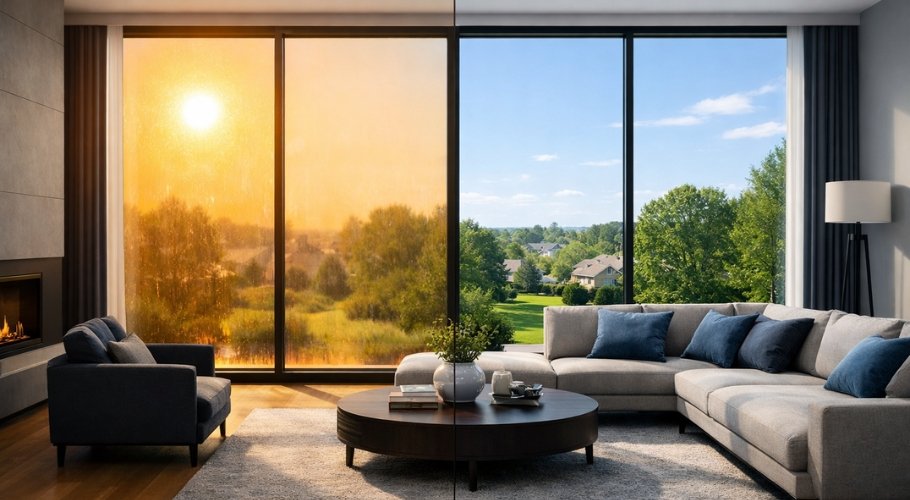
Premium spectrally selective films are engineered to allow visible light to pass through freely while blocking a significant portion of infrared heat and ultraviolet radiation. The result is a window that looks and feels essentially the same from the inside — clear, bright, connected to the outdoors — but performs as a thermal and UV barrier simultaneously.
The key performance metric to understand is Total Solar Energy Rejected, or TSER. This single figure represents what percentage of the sun’s combined solar energy a film blocks. Entry-level films may deliver a TSER of 25% to 35%. Mid-range films reach 45% to 55%. Premium nano-ceramic films can achieve TSER ratings of 60% to 80% — all without meaningfully altering the visible appearance of your glass.
UV blocking is a separate but related figure. The best films block 99% or more of UV radiation regardless of TSER rating, meaning even lighter, nearly invisible films can offer near-total UV protection.
Princeton-Specific Considerations Before You Install
Historic and older homes require special attention. Princeton has a remarkable concentration of pre-war architecture — homes with original single-pane windows, wood frames, and period glass. Some of these windows are irreplaceable. Film installation on older single-pane glass carries fewer thermal stress concerns than with modern double-pane units, but surface preparation and adhesion compatibility should be evaluated carefully by an experienced installer.
Double-pane and Low-E windows need compatibility verification. Many newer Princeton homes and commercial buildings — particularly along the Route 1 corridor and newer residential developments — feature double-pane insulated glass units (IGUs) with Low-E coatings already applied. Installing the wrong film on Low-E glass can cause solar heat to become trapped within the sealed air gap, building thermal stress that may eventually crack or seal-fail the unit. Not all films are compatible with all Low-E configurations. This is a non-negotiable verification step before any installation.
Orientation matters significantly in Princeton. The town’s mix of architectural styles means window orientations vary widely. South- and west-facing windows in Princeton receive the highest solar load — a west-facing great room or home office that catches afternoon sun from June through September is the highest-priority target for solar control film. North-facing windows in Princeton’s older neighborhoods may have almost no solar control need but could benefit from UV-only or insulating film for winter performance.
Commercial properties along Nassau Street and Route 1 have different needs than residences. Retail storefronts need glare reduction and UV protection without losing the visual clarity that draws customers. Office spaces benefit from consistent interior temperatures that reduce HVAC cycling. Restaurants and hospitality businesses care about maintaining an inviting atmosphere while controlling solar heat gain at window-side seating. The film specification for each of these use cases is meaningfully different.
The Film Types Most Relevant to Princeton Properties
Nano-ceramic solar control film is the most broadly applicable option for Princeton’s climate. It handles summer heat rejection effectively, provides strong UV blocking year-round, and doesn’t interfere with electronic signals — relevant for both residential smart home systems and commercial environments. Its neutral appearance makes it suitable for Princeton’s aesthetically sensitive historic districts.
Low-emissivity (Low-E) window film adds a layer of winter insulation value by reflecting interior heat back into the room rather than allowing it to escape through the glass. For Princeton homes with single-pane windows that can’t be immediately replaced, this is a cost-effective way to meaningfully improve thermal performance in both directions.
Safety and security film deserves mention for ground-floor commercial properties on Nassau Street and the surrounding downtown area. These films hold glass together on impact, slowing forced entry and reducing injury risk from breakage. They’re often combined with solar control properties in a single product.
Privacy and decorative film is relevant for Princeton’s many conference rooms, professional offices, and medical practices. Frosted or patterned films provide visual privacy without blocking natural light — an important consideration in buildings where daylighting is part of the design intent.
What to Ask Before You Commit
Before selecting a film or scheduling installation, a few practical questions are worth raising with any window film professional:
Is this film compatible with my specific glass type? Ask for confirmation in writing if your windows are double-pane or have existing Low-E coatings.
What is the warranty — and what does it cover? Premium films carry manufacturer warranties of 10 to 15 years on residential applications and often separate commercial warranties. Understand what voids coverage.
What will this film look like from the street? For Princeton’s historic and design-conscious neighborhoods, exterior appearance is a legitimate concern. Ask to see samples in natural light.
Is the installer experienced with both residential and commercial applications in central New Jersey? Regional experience with Princeton’s specific building stock — and familiarity with local permit considerations for historic properties — matters.
A Note on Timing
Window film can be installed year-round, but spring installations in Princeton offer a practical advantage: the film cures and settles before peak summer heat arrives, and you gain the full cooling season benefit from day one. Fall installations ahead of winter similarly position Low-E and insulating films to perform through the heating season immediately.
To understand which specific film type genuinely suits your Princeton property — whether it’s a historic residence, a modern townhouse, or a commercial space along Nassau Street — speaking with a local specialist who knows central New Jersey’s building conditions is well worth the time.