Too much glare and too little privacy: a princeton, NJ tinting guide
There’s a particular kind of frustration that’s common in Princeton homes and offices. The kind where you’ve paid for a beautiful space — good light, thoughtful design, quality finishes — and then spend half the day adjusting blinds, repositioning screens, or simply avoiding certain rooms because the sun has made them either unbearable to look toward or uncomfortably exposed to the street.
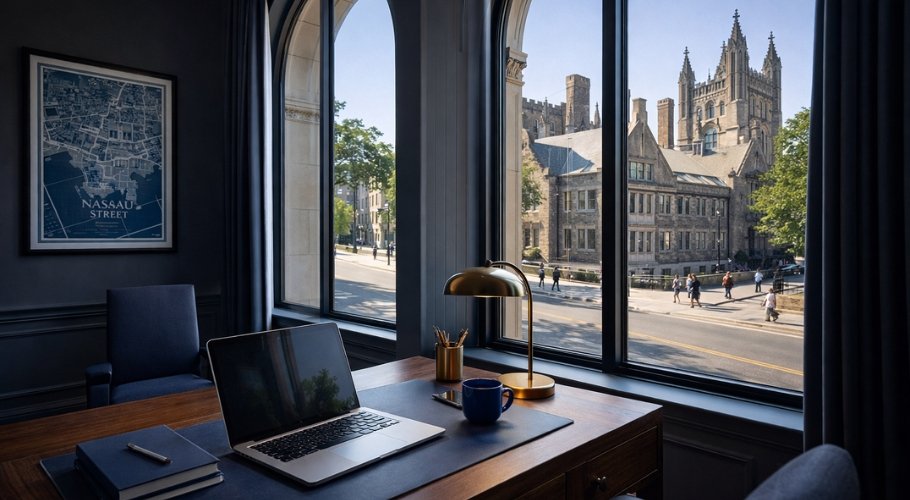
Glare and privacy are two separate problems. But in Princeton, they tend to arrive together. The same large windows that flood a Nassau Street office with morning light create a fishbowl effect for anyone working near the glass. The same south-facing great room in a Western Section home that gets gorgeous afternoon sun makes the television unwatchable from October through March when the sun drops lower and hits the glass at a flatter angle. The same glass that makes a Princeton Junction townhouse feel open and airy means anyone walking past can see directly into your living room after dark.
These are not minor inconveniences. They shape how spaces function, how comfortable people feel in them, and — in commercial settings — how productive or presentable a business appears to clients and customers.
Window film addresses both problems simultaneously, and Princeton’s specific mix of historic architecture, modern commercial development, and diverse residential stock makes it one of the more interesting places to think through how these solutions apply in practice.
Understanding Glare: Why It’s Worse Than Most People Realize
Glare is not simply too much light. It is light at a contrast ratio that exceeds what the human eye can comfortably resolve — typically when a bright light source appears in or near the field of vision while the surrounding environment is significantly dimmer.
In residential settings, this most commonly appears as monitor or television glare during morning or afternoon hours when direct sunlight enters at a low angle. In commercial settings — particularly in Princeton’s downtown offices and the Route 1 corridor businesses — it manifests as screen glare, reflective surfaces, and the uncomfortable brightness that makes client-facing areas feel harsh rather than welcoming.
Princeton’s geography contributes specifically to this problem. The town’s mix of east-west and north-south street orientations means that depending on a property’s position and window facing, direct low-angle sun can enter rooms at particularly harsh angles during morning and late-afternoon hours. Winter months, when the sun tracks lower across the sky, extend this glare problem into more hours of the day than most homeowners initially anticipate when they move in.
The relevant performance metric for glare control is Visible Light Transmission, or VLT — the percentage of visible light a film allows through — combined with the film’s Glare Reduction percentage. Premium glare-control films reduce incoming glare by 60% to 85% while maintaining a VLT that still feels bright and naturally lit from the interior. The result is that rooms stop feeling harsh and become genuinely comfortable to occupy throughout the day, regardless of sun angle.
Understanding Privacy: The Glass Problem That Gets Worse After Dark
Privacy through glass operates on a simple optical principle — and one that most homeowners don’t fully think through until they experience it in their own home.
During daylight hours, one-way privacy is possible through film because the exterior of the glass is brighter than the interior. A person outside looking in sees the reflection of the brighter exterior, not the dimmer interior. This is the basis for reflective and tinted films that provide daytime one-way vision.
After dark, this reverses. When interior lights are on and the exterior is dark, the interior becomes the brighter environment — and glass becomes fully transparent from outside regardless of any daytime privacy film. This nighttime transparency is something frosted or decorative films address more completely, because they create diffusion rather than relying on the brightness differential that disappears after sunset.
Princeton’s mix of housing situations makes this distinction practically important. A homeowner in a Western Section neighborhood on a tree-lined street has a different privacy calculus than a resident in a Princeton Junction townhouse development where homes sit closer together and face each other across a narrower gap. A ground-floor medical office on Nassau Street has different requirements than a second-floor residential apartment above a retail space in downtown Princeton.
Understanding which type of privacy problem you’re actually solving determines which film solution is appropriate.
The Film Solutions Relevant to Princeton Properties
Spectrally selective solar control films address glare without significantly altering visible light transmission or creating a strongly reflective exterior appearance. They achieve their glare reduction by targeting specific wavelengths of light — primarily infrared and high-intensity visible light — while preserving the quality of natural light entering the room. For Princeton homeowners who want to reduce glare without making their windows look tinted or mirrored from the street, this is the most aesthetically compatible solution. Glare reduction of 60% or more is achievable while maintaining a VLT that feels open and naturally lit.
Reflective and privacy films work through higher exterior reflectivity — a mirrored or semi-mirrored surface that makes the glass appear as a reflective surface from outside while remaining visible from within. These provide strong daytime privacy and meaningful glare reduction. The trade-off is exterior appearance — Princeton’s historically sensitive neighborhoods and many of its HOA-governed residential developments may have restrictions on highly reflective window treatments. This is worth verifying before selecting a reflective film in Princeton’s older neighborhoods or planned communities.
Frosted and decorative films provide the most complete privacy solution because they create diffusion rather than one-way vision — and that diffusion works in both daylight and low-light conditions. They are particularly applicable to Princeton’s significant population of home offices, conference rooms, medical and professional practices, shower and bathroom glass, and any interior glass partition where total visual privacy is the requirement. Frosted films can be applied to partial sections of glass — lower panels only, for example — to maintain privacy at seated or standing eye level while preserving sightlines and light transmission above. They can also be cut to custom patterns that respect Princeton’s design-conscious aesthetic.
Switchable smart glass film represents a technology step further — films that shift from transparent to frosted on demand through a wall switch, dimmer, or smartphone application. For Princeton’s growing population of flex-office spaces, conference rooms, and high-end residential applications, switchable film converts any glass partition into a dynamic privacy solution. It’s particularly relevant in Princeton’s Route 1 corridor office parks and the newer commercial buildings near Princeton University’s research and innovation campus, where conference room glass serves both open and confidential functions throughout the day.
Princeton-Specific Applications Worth Knowing About
Historic residential properties in the Western Section and Nassau Street corridor require films that respect architectural character. Heavy reflective tints or darkened glass are typically inappropriate for these properties — both aesthetically and potentially from a historic preservation standpoint. Spectrally selective films with neutral appearance and frosted films applied to strategic glass sections are the most compatible choices for Princeton’s older residential and commercial stock.
Princeton University area properties — graduate student housing, faculty residences, university-adjacent offices — frequently deal with both glare from extended screen time and privacy concerns from proximity to campus pedestrian traffic. Solar control films with moderate glare reduction and frosted or privacy films for ground-floor and eye-level glass represent the most practical combination for these settings.
Route 1 commercial corridor offices deal primarily with glare on screens and productivity loss from harsh direct sun during morning and afternoon hours. Spectrally selective or light-control films installed on east- and west-facing glass panels — the orientations that receive direct low-angle morning and afternoon sun respectively — address this specifically without requiring a whole-building film specification.
Medical, legal, and professional practices throughout Princeton share a common requirement: patient and client confidentiality in consultation spaces, combined with a professional, welcoming appearance. Frosted film on lower glass panels of street-level offices, combined with clear or lightly tinted film on upper glass for light transmission, is a cost-effective and highly effective solution that many Princeton professional practices have already adopted.
Princeton Junction residential and townhouse developments deal with a specific proximity issue — homes and units positioned close enough to each other that privacy from neighboring windows is a genuine daily concern, particularly on side and rear elevations. Privacy film solutions for these settings often involve a combination of daytime reflective film on primary windows and frosted film on bathroom, bedroom, and closer-proximity glass.
What to Consider Before Selecting a Film in Princeton
Glass type compatibility remains non-negotiable. Princeton’s substantial stock of double-pane windows — standard in most construction from the 1990s onward — requires films selected specifically for compatibility with sealed insulated glass units. Higher-absorption films on double-pane glass can create thermal stress in the sealed unit over time. Any professional assessment should include glass type verification.
HOA and historic district guidelines are worth checking in advance. Some Princeton residential communities and historic neighborhoods have guidelines on exterior appearance changes including window treatments. Neutral-appearance films are broadly compatible with these guidelines, but highly reflective options may require approval.
Partial application is a valid and often overlooked approach. Privacy and glare needs are not always uniform across all glass in a space. Applying frosted film to lower panels only, or installing glare control film on west-facing windows while leaving north-facing glass untreated, allows a precise response to actual conditions rather than a whole-home specification.
To understand which combination of glare control, privacy, and solar performance genuinely suits your specific Princeton property — whether it’s a historic home in the Western Section, a professional office downtown, or a townhouse near Princeton Junction — speaking with a local window film specialist who understands Princeton’s architectural diversity and regional conditions is the most direct path to the right answer.
The Practical Outcome
What glare control and privacy film ultimately delivers in a Princeton context is the ability to use your space as it was designed to be used — without behavioral workarounds. No repositioning desks to escape glare. No closing blinds and losing the natural light you paid for. No feeling exposed in your own living room after dark. No conference rooms that can’t hold a confidential conversation because the glass walls advertise it to the hallway.
The right film, applied to the right glass, makes these problems stop being part of daily life. In a town where properties are valued for their quality and character, that kind of quiet, permanent upgrade has a straightforward appeal.