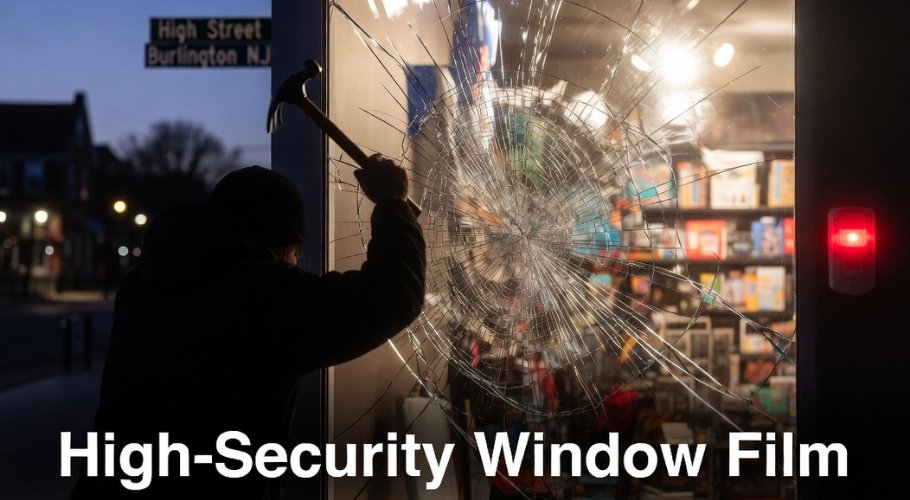
Stop the Smash-and-Grab: High-Security Window Films for Burlington Retailers.
The storefront window has always been a retailer’s most powerful marketing tool and its most vulnerable physical asset — both at once. In Burlington, where commercial activity runs along High Street’s historic district, fans out along Route 130’s busy corridor, and extends into neighborhood retail pockets throughout Burlington Township and Edgewater Park, that vulnerability is something every business owner either thinks about consciously or discovers the hard way.
A smash-and-grab isn’t a sophisticated crime. It’s fast, opportunistic, and devastatingly simple: break the glass, reach or walk in, take what’s accessible, leave before anyone responds. The entire event typically takes under 60 seconds. Standard storefront glass — the kind separating your merchandise from the sidewalk right now — offers approximately zero resistance. A single blow from a hammer, a rock, a bat, or even a heavy boot converts it from a barrier into an open doorway in under two seconds.
The question for Burlington retailers isn’t whether their glass is vulnerable. It is. The question is whether that vulnerability has been addressed — and what it would actually take to make an opportunistic criminal decide your storefront isn’t worth the effort.
Burlington’s Retail Crime Reality: The Numbers That Matter
Understanding the security case for Burlington retailers starts with understanding the local crime environment honestly. Burlington’s rate for property crime is 19 per one thousand population, with a 1 in 52 chance of becoming a victim of any property crime — above the national average across American communities of all sizes. Over the last five years, Burlington has seen increasing property crime trends, even as the overall crime rate has moved modestly.
Burlington County’s property crime rate runs slightly higher than the national average, driven primarily by burglary, theft, and motor vehicle theft — the categories that most directly threaten retail businesses with ground-floor glass exposure.
These numbers don’t paint Burlington as a high-crime city — it isn’t. But they do confirm what most business owners along Burlington’s commercial corridors already know intuitively: the threat to commercial glass is real, it’s ongoing, and it concentrates on exactly the types of retail storefronts — jewelry, electronics, boutique apparel, convenience goods — where visible merchandise sits directly behind unprotected glass.
The businesses that become targets for smash-and-grab aren’t randomly selected. They’re chosen because they look accessible. Because the glass looks standard. Because the response time of any alarm-triggered law enforcement — typically six to ten minutes in suburban New Jersey — represents a window of opportunity that takes seconds to exploit and minutes to complete.
Changing that calculus doesn’t require turning a storefront into a fortress. It requires making the glass significantly harder to breach quickly — and that’s exactly what security window film is engineered to do.
Why Standard Storefront Glass Is the Weakest Link in Any Commercial Security Plan
Most Burlington retailers have invested meaningfully in security: alarm systems, surveillance cameras, motion sensors, deadbolts on rear entries. These are all genuine deterrents and detection tools. But they share a common limitation — they respond to a breach after it begins. The alarm sounds when the glass breaks. The camera captures the image of someone who is already inside. The sensor triggers after the point of entry has been compromised.
None of these systems harden the glass itself. Standard commercial glass — whether single-pane plate glass, tempered glass, or basic insulating units — is engineered for optical clarity and weather resistance. It is not engineered to resist impact. A single-pane storefront window fractures on a moderately forceful blow. Tempered glass, counterintuitively, shatters more completely than standard glass when it fails — breaking into small, relatively safe pieces but clearing the opening almost instantly.
In most opportunistic property crimes, entry is fast; increasing the time and effort required to breach a window is one of the most effective deterrents available, because smash-and-grab criminals are, by definition, choosing targets that yield quick access with minimal resistance.
This is the strategic logic behind security window film. It doesn’t replace alarms or cameras. It works before them — giving those systems time to function by ensuring that breaking the glass doesn’t immediately mean clearing the opening.
The Science of Security Film: How It Transforms Glass Behavior
Security window film is a multi-layer polyester laminate applied to the interior surface of existing commercial glass. When glass treated with security film is struck, something fundamentally different happens compared to untreated glass.
Untreated glass fractures and either falls inward or outward, depending on the force vector and glass type. The opening is cleared. Entry is immediate. When security film is present, the strong adhesive and high tensile strength hold shattered glass fragments together, transforming the glass into a resilient membrane that remains in the frame. This significantly delays entry, creates noise, and deters intruders.
The film doesn’t prevent the glass from cracking under a hard enough blow — it’s not designed to. What it does is prevent the glass from clearing the opening. The pane spiderwebs, the fragments bond to the film, and the resulting glass-and-film membrane continues to occupy the frame. An intruder now faces a dramatically different problem: instead of stepping through a cleared opening in under two seconds, they must continue striking an increasingly resistant, increasingly noisy target, repeatedly, while the alarm is sounding, while time is passing, and while the calculus of risk shifts decisively against them.
Practical safety groups and Department of Homeland Security guidance both note that most opportunistic property crimes are fast — and that increasing the time and effort required can meaningfully reduce the risk, because smash-and-grab criminals select targets that yield quick access with minimal resistance. Security window film directly attacks that selection logic.
Thickness, Specifications, and What They Mean for Burlington Storefronts
Not all security film is equivalent — and for Burlington retailers making a purchasing decision, understanding the specification hierarchy is the difference between genuine protection and a false sense of security.
Commercial security window film typically ranges from 4 mils to 21 mils in thickness. Thicker films generally offer greater impact resistance and extended delay times, with 7-mil films providing substantial protection against smash-and-grab attempts, while 14-mil or thicker films are often employed for advanced blast mitigation purposes.
For context: one mil is one-thousandth of an inch. Standard window glass in a commercial storefront is typically 3mm to 6mm thick — far thicker than any film — but glass fails by fracture, not by penetration. The film’s job isn’t to add structural thickness. It’s to maintain cohesion after fracture. The film’s tensile strength, its adhesive bond to the glass surface, and — critically — its attachment to the frame are what determine how long it maintains that cohesion under sustained attack.
For Burlington retail applications, the right specification depends on the specific threat profile and the type of merchandise at risk:
Entry-level protection (4–6 mil): Appropriate for lower-risk retail environments where the primary concern is accidental breakage, minor vandalism, or opportunistic low-force attempts. Provides meaningful fragment retention and some delay benefit, but limited resistance against determined repeated blows. Suitable for interior glass partitions, secondary windows, and office applications.
Standard smash-and-grab protection (7–8 mil): The 7-mil threshold is the industry standard specifically recommended for protection against smash-and-grab attempts. At this thickness, the film provides sufficient tensile strength to hold a glass membrane under multiple repeated impacts, creating the noise and delay profile that deters opportunistic intruders. This is the appropriate baseline for Burlington storefronts on High Street, Route 130 commercial corridors, and neighborhood retail locations with visible merchandise.
High-value retail and repeat-risk environments (12–14 mil): For Burlington retailers carrying high-density valuable inventory — jewelry, electronics, premium apparel, licensed goods — thicker film specifications provide extended delay time under more sustained and determined attacks. For retail applications with significant loss exposure, 8–12+ mil films matched to the risk level are the professional recommendation.
Advanced forced-entry resistance (14–21 mil): Reserved for environments with elevated security requirements — financial services, pharmacies carrying controlled substances, or businesses that have experienced prior break-ins. At this thickness level, films are engineered to resist repeated blunt-force attacks from multiple weapon types while maintaining the glass-and-film membrane throughout the event.
The Attachment System: The Component Most Retailers Don’t Know About
Film thickness is important. It is not, by itself, the complete picture of security performance. There is a second variable that dramatically affects how a filmed window performs under real-world attack conditions — and it’s the variable that separates professional installation from a DIY film application or a budget-focused installer who skips the discussion.
That variable is the edge attachment system.
When security film holds shattered glass together, the resulting glass-and-film membrane is only as strong as its connection to the surrounding frame. A filmed glass pane with no frame attachment can be pushed inward as a single unit — the film held the glass together, but the assembly didn’t stay in the opening. An intruder can then remove or bypass the glass panel from the frame, defeating the film’s retention function entirely.
Security films are multi-layer polyesters bonded to the glass with pressure-sensitive or dry adhesives. When paired with a proper edge attachment system that anchors the filmed glass to the frame, the film-and-glass composite better resists being pushed through after breakage. Many systems are tested to glazing and impact standards to demonstrate performance in forced-entry scenarios.
For Burlington retail storefronts, the two primary attachment system options are:
Wet-glaze anchoring: A structural silicone sealant is applied between the film edge and the window frame, chemically bonding the film perimeter to the frame material. When the glass fractures and the film membrane forms, the wet-glaze bond holds that membrane to the frame at every edge simultaneously. This is the standard professional specification for retail smash-and-grab protection in commercial applications.
Mechanical anchoring: In higher-security applications or on frames where wet-glaze adhesion is compromised by frame material or condition, mechanical anchors can be installed at structural points to physically pin the film-and-glass assembly to the frame structure. This approach is typically reserved for the highest-risk or highest-value applications.
For most Burlington retail storefronts with standard aluminum or vinyl commercial frames in good condition, wet-glaze anchoring combined with 7–8 mil film represents the complete specification for effective smash-and-grab protection. The film handles fragment retention. The wet-glaze handles frame retention. The combination creates the delay-and-deter outcome that security film is designed to deliver.
The Delay-Deter-Deny Framework: What Burlington Retailers Should Realistically Expect
Security window film is a physical delay and deterrence tool. Understanding what it does — and what it doesn’t — ensures Burlington business owners make installation decisions with accurate expectations.
What it does: The primary goal of security window film is to create a significant obstacle for would-be intruders by delaying their entry — holding shattered glass firmly in place and forcing the perpetrator to exert considerably more effort and time to breach the window. This buys valuable time for alarms to sound, for someone to react, or for law enforcement to respond. It also changes the acoustic signature of a break-in attempt dramatically. A standard glass break is a single loud event followed by silence. A film-reinforced glass breach is a sustained series of impacts against a resistant surface — noisier, longer, and far more visible to passersby, neighboring businesses, and surveillance systems.
What it doesn’t do: Security film doesn’t make glass impenetrable. A sufficiently determined attacker with enough time and the right tools can eventually breach a filmed window. The goal is delay and retention: making entry harder and keeping glass together to reduce hazards — not making glass invincible against every threat. Film is most effective against opportunistic, time-sensitive smash-and-grab attempts — precisely the category most common in Burlington’s retail crime environment.
How it fits the security system: Security film works best as a component of a layered security strategy. While it dramatically enhances window integrity and delays access, it works best when integrated with other security measures like alarms, surveillance cameras, and access control systems. The film buys valuable time for these systems to respond. A Burlington retailer with film-reinforced glass, a monitored alarm system, and visible camera coverage has created a significantly less attractive target than any comparable business with cameras and alarms alone — because the criminal now has to spend time and generate noise at the most public and visible point of entry before any of those other systems can generate consequences.
Additional Benefits That Come With Security Film for Burlington Retailers
Security performance is the primary reason Burlington retailers install this product — but it doesn’t operate in isolation. Professional-grade security film delivers several additional benefits that compound the value of the investment:
UV protection and interior preservation: Security film blocks up to 99% of the sun’s UV rays — the largest single cause of interior fading — protecting merchandise, displays, and interior finishes from solar degradation. For Burlington retailers displaying merchandise in south- or west-facing windows, this UV protection directly extends the displayable life of products and prevents the faded-merchandise problem that reduces perceived product value.
Shatter protection for occupants and customers: Beyond the security application, glass retention film dramatically reduces the injury risk associated with accidental breakage — from a wayward baseball, a vehicle impact, a slip near a glass door, or severe weather. For retail environments where staff and customers are present during business hours, this passive safety function has genuine value independent of any security benefit.
Optically clear installation: Clear security film maintains full storefront visibility — an invisible protection layer that preserves the appearance and transparency that retail merchandising requires. Burlington retailers don’t have to choose between security and the visual presentation their storefront depends on. The film is applied to the interior glass surface, remains essentially invisible from the exterior, and doesn’t alter the window’s appearance in any way that would affect either customer perception or Burlington’s commercial district aesthetic standards.
Solar heat and glare control options: For Burlington retailers whose storefronts face south or west and experience afternoon heat and glare in the showroom, tinted security film specifications are available that combine the fragment retention of standard security film with meaningful solar heat rejection and glare reduction. This dual-function specification provides security performance while also reducing the air conditioning load on the retail space during South Jersey’s peak summer months.
Practical Guidance for Burlington Retail Business Owners
Before scheduling an installation, a few decisions and assessments will ensure the result matches the actual risk environment:
Map your vulnerable glass: Not all glass in a Burlington commercial space carries equal risk. Ground-level storefront windows facing public sidewalks or parking lots are the primary smash-and-grab vectors. Glass doors — particularly those with large lites — are the second priority. Interior glass partitions and upper-floor windows typically carry minimal smash-and-grab risk and may warrant different specifications or no film at all.
Match the specification to the merchandise: A Burlington boutique displaying $150 scarves and a Burlington jeweler displaying $5,000 watches have different loss exposure profiles — and the appropriate film specification differs accordingly. Film thickness and attachment system selection should reflect the actual value at risk, not simply minimum-cost coverage.
Assess frame condition before specifying attachment: Wet-glaze attachment systems require frame surfaces that are clean, structurally sound, and compatible with silicone adhesion. Older Burlington storefronts with deteriorated or painted frames may require frame preparation before attachment installation. A qualified installer will assess frame condition before quoting a complete system.
Consider the complete after-hours picture: Smash-and-grab events almost always occur during low-visibility hours — late evening, overnight, or early morning. Retailers who operate in Burlington’s commercial corridors should evaluate whether their existing camera and alarm coverage generates an adequate response in that time window, and whether film-extended delay time changes the probability of a successful response.
Don’t neglect the door glass: Display windows get the most attention, but glass commercial doors — particularly those with full-length glass panels — are frequently the actual entry point in smash-and-grab events because they provide a larger opening with a single break. Door glass should be included in any security film specification for a Burlington retail location.
To get a professional assessment of the specific glass vulnerabilities in your Burlington commercial space and the film specification that matches your merchandise, risk profile, and budget, consider speaking with a local window film specialist who understands both the technical requirements and the specific retail security environment in Burlington County.
Conclusion
Standard storefront glass is not a security feature. It is a display surface that happens to separate your merchandise from anyone willing to break it. In Burlington’s current retail environment — where property crime rates run above national averages and where the speed and simplicity of smash-and-grab incidents make standard deterrents insufficient — leaving that glass unaddressed is a genuine business risk.
High-security window film changes the physics of the threat. It converts a two-second breach into a sustained, noisy, increasingly resistant ordeal that most opportunistic criminals will abandon before they ever access your inventory. Combined with a professional wet-glaze attachment system, the right mil specification for your risk profile, and your existing alarm and camera infrastructure, it forms the first layer of a security system that actually starts at the glass — where commercial burglaries always begin.
The glass doesn’t have to be the weakest link. For Burlington retailers who’ve decided it won’t be, the solution is already proven, professionally available, and waiting to be installed on a schedule that doesn’t disrupt a single business hour.