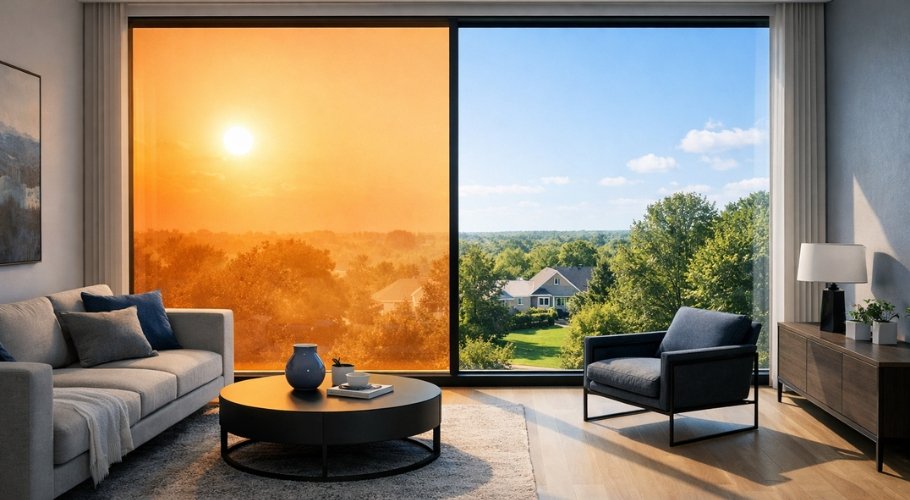
Why Are Mount Laurel Homeowners Obsessed With Blocking Summer Heat?
A complete guide to what’s really happening inside your windows — and what smart South Jersey residents are doing about it.
If you’ve spent a summer afternoon in a Mount Laurel home, you already know the feeling. You walk from a perfectly air-conditioned hallway into a sun-facing living room — and the temperature shifts noticeably. The blinds are shut. The AC is running. But that room still bakes.
This isn’t just a comfort issue. It’s a physics problem. And for thousands of homeowners in Mount Laurel and neighboring Burlington County communities, the solution isn’t a new HVAC unit or thicker curtains. It’s something applied directly to the glass itself.
Solar heat control window film has become one of the most quietly popular home upgrades in South Jersey — and for good reason. Let’s break down exactly why Mount Laurel homeowners are gravitating toward it, what the science says, and how to know if it’s right for your property.
Mount Laurel’s Summer Reality: Numbers You Should Know
Mount Laurel sits in Burlington County, New Jersey — a zone that experiences genuinely intense mid-Atlantic summers. July average highs regularly reach 85°F to 86°F, but the real story is the heat index. When humidity factors in, the perceived temperature during peak July can climb to nearly 97°F. That’s not just uncomfortable — it’s a direct tax on your cooling system.
What makes this particularly relevant is the compound effect of heat and UV exposure. Between May and August, Mount Laurel receives some of the highest UV index readings of the year, consistently in the moderate-to-high range during daylight hours. That sustained solar radiation doesn’t just warm your rooms — it fades furniture, damages flooring finishes, and degrades fabrics over time.
The surrounding communities of Moorestown, Marlton, Evesham, and Cherry Hill face the same seasonal challenge. But Mount Laurel, with its concentration of newer single-family homes and townhouses featuring large windows and open floor plans, tends to amplify the problem. Modern architecture prioritizes natural light — which is beautiful, until July arrives.
Where the Heat Is Actually Coming From
Here’s something many homeowners don’t realize: up to 40% of the unwanted heat entering a home during summer comes through the windows. Not through the roof. Not through the walls. Through the glass.
Standard glass — even double-pane glass — does very little to stop infrared radiation, which is the primary heat-carrying component of sunlight. Visible light passes through, which is what you want. But infrared rays ride alongside that light and convert to heat once inside the room. Ultraviolet rays come along too — invisible but relentless — responsible for roughly 40% of interior fading damage to floors, furniture, and artwork.
“Up to 40% of summer heat gain enters through windows — not walls, not the roof. The glass itself is the gap in your home’s thermal defense.”
This is the core problem that window film technology was engineered to solve. And the science behind modern films is considerably more advanced than most people expect.
The Technology Behind Heat-Blocking Window Film
Today’s premium solar control films are not the dark, mirrored tints of the 1990s. Advanced ceramic and spectrally selective films are often barely visible once installed — yet they perform as precision solar barriers.
The key metric to understand is Total Solar Energy Rejected (TSER). This figure represents the percentage of the sun’s total energy — including visible light, infrared heat, and UV radiation — that the film prevents from passing through the glass. For quality residential films, TSER ratings commonly range from 40% to 80%, depending on film grade.
Spectrally selective films take this further by distinguishing between types of solar energy. They’re engineered to allow natural visible light to pass through while specifically targeting the infrared spectrum — the heat-causing component. The result is a room that stays bright and naturally lit, while the thermal load drops dramatically. Premium nano-ceramic films can reject up to 84% of solar heat while blocking 99% or more of UV radiation.
What This Means for a Mount Laurel Home in Practice
Consider a south- or west-facing room in a Mount Laurel colonial or townhouse — the type of exposure that takes the full force of afternoon sun. Without film, that room becomes the household’s problem space: shades drawn, AC struggling, family avoiding it after noon. Hardwood floors near the windows show discoloration. A couch faded unevenly. A constant undercurrent of heat even when the rest of the house feels comfortable.
With the right solar film installed on those windows, the dynamic shifts noticeably. The glass still transmits natural light, but the thermal load drops substantially. The air conditioning cycles less frequently and maintains temperature more consistently.
Homeowners who prioritize south- or west-facing installations often report that formerly avoided rooms become comfortable again — not just in terms of temperature, but glare. High-performance films can reduce glare by 70% or more, which makes a significant difference wherever screens, televisions, or workspaces are involved.
The energy savings dimension is real too. Research from the International Window Film Association indicates that solar control films can reduce annual cooling costs by 5% to 15% in applicable climates — with premium installations in high-sun-exposure homes achieving closer to 30%. For a South Jersey household running central air conditioning from late May through September, that accumulates into meaningful savings over a film’s lifespan of 15 to 20 years.
Basic vs. Premium Films: Understanding the Difference
Not all window films deliver the same results, and it’s worth understanding where the performance gap lies before making a selection.
Entry-level tinted films work primarily through absorption — they darken the glass and absorb solar energy. The limitation is that absorbed energy eventually radiates back into the room. These films also tend to develop a bronze or blueish hue over time.
Mid-tier reflective metallic films offer improved heat rejection through reflection rather than absorption alone. They can provide strong TSER ratings but may interfere with WiFi or cell signals and give windows a mirrored exterior appearance.
Premium nano-ceramic films represent the current state of the art. They use microscopic ceramic particles — non-metallic — to achieve high heat rejection without signal interference, without a reflective exterior look, and with excellent long-term color stability. These films carry the strongest performance warranties and are compatible with the double-pane windows common in Mount Laurel’s newer housing stock.
Transitional photochromic films add adaptability by responding to the intensity of direct sunlight, shifting from a lighter state to a slightly tinted state as UV exposure increases. Particularly effective in South Jersey’s variable spring and fall conditions.
Practical Guidance for Mount Laurel Homeowners
Prioritize by orientation. South- and west-facing windows receive the highest solar load in New Jersey and benefit most from high-TSER films. North-facing windows rarely need significant solar control.
Consider your glass type. Double-pane windows require films with lower solar absorption to avoid thermal stress. Verify compatibility — especially with Low-E glass, which already has some built-in solar control properties.
Think beyond summer. Quality films provide year-round value. UV protection is relevant every season, and some Low-E formulations also improve winter insulation by reflecting interior heat back into the room.
Match film visibility to your preferences. Spectrally selective and ceramic films achieve strong performance while maintaining a neutral, natural glass appearance. Higher-reflectivity options exist if maximum heat rejection is the priority.
Professional installation matters. Film performance and longevity are significantly affected by installation quality — proper surface preparation, edge sealing, and bubble elimination affect both aesthetics and long-term durability.
A Solution Quietly Growing in Burlington County
The reason Mount Laurel homeowners are increasingly drawn to solar control window film isn’t complicated: it solves a real, measurable problem without structural changes, replacement windows, or significant disruption to the home.
A film installation on a standard residential window is completed in a single day. The performance is immediate. And the protection — from heat, glare, and UV damage — continues working passively for years. In a housing market where homes feature larger windows, open-plan layouts, and premium interiors worth protecting, the logic is straightforward.
The same benefits that apply in Mount Laurel extend to nearby Marlton, Moorestown, Hainesport, and communities throughout South Jersey and the Burlington County corridor. Regional climate patterns are essentially identical — the solutions transfer directly.
To understand what specific film specification genuinely suits your home’s orientation, window type, and comfort priorities in Mount Laurel, consider speaking with a local window film specialist who understands South Jersey’s regional climate conditions.