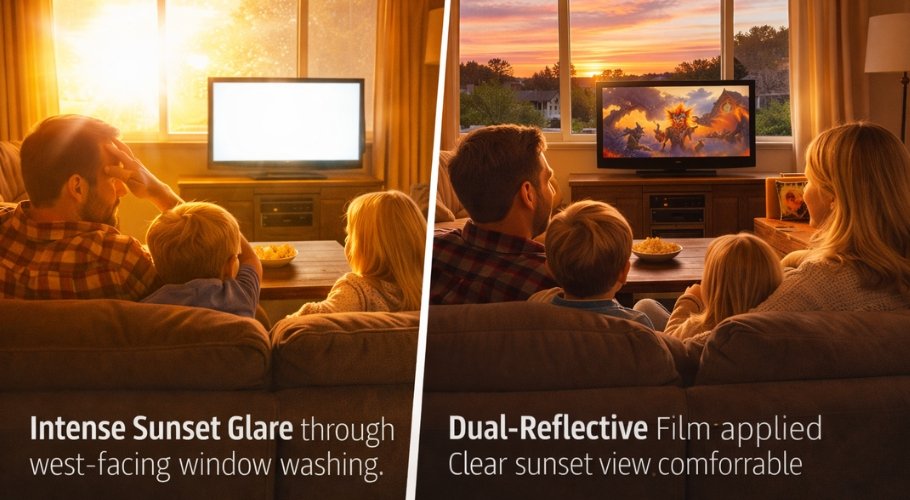
The Sunset-Struggle: How Dual-Reflective Film Fixed a TV Glare Crisis in a Burlington Split-Level.
It starts around 5:30 PM in the summer. The sun drops over the Delaware River valley, swings its full weight toward the western side of the house, and turns your Burlington living room into a light tunnel. The TV becomes a $1,200 mirror. Conversation gets interrupted with a chorus of “can you close the blinds?” The room that everyone loved all morning is suddenly the room no one wants to be in until 7:30.
This isn’t a minor annoyance. For families in Burlington’s split-level homes — a housing style that runs throughout Burlington Township, Cinnaminson, Edgewater Park, and surrounding Burlington County neighborhoods — the west-facing living room or lower-level family room is often the heart of the house. It’s where the sectional is, where the television lives, where homework gets done and evenings get spent. And during the months of May through September, the setting sun effectively hijacks it for two hours every single day.
Curtains are the instinctive answer. But curtains that block that level of western sun also block the rest of the room’s light and view. After closing blinds every evening for a summer or two, most Burlington homeowners start wondering whether there’s a solution that doesn’t require choosing between a usable room and an unwanted light show.
Dual-reflective window film is that solution — and understanding why it works requires understanding something most people don’t know about how light, glass, and film actually interact.
The Split-Level Problem: Why Western Exposure Hits So Hard
Split-level homes became one of New Jersey’s most popular post-war residential designs for good reason. The staggered floor plan maximizes usable square footage on modest lot sizes, creates natural separation between living, sleeping, and utility spaces, and typically places the main living room and family room on the western side of the house where afternoon light floods in during the day.
That afternoon light is wonderful from about 10 AM to 4 PM. After that, Burlington’s geographic position along the Delaware River creates a specific solar condition that makes western exposure uniquely challenging.
Burlington sits on the eastern bank of the Delaware River, facing broadly west across open water. Unlike neighborhoods screened by dense tree lines or taller adjacent buildings, many Burlington-area streets have relatively open western horizons — meaning the setting sun travels an unobstructed path directly into west-facing glass for an extended arc every evening. The Delaware River’s surface can compound this by reflecting additional low-angle light upward, creating a double-source glare effect that hits the lower half of windows at angles standard blinds don’t capture well.
Add the flat topography of Burlington County’s coastal plain — there are no hills to block early evening sun — and you have a glare environment that’s reliably punishing every clear evening from spring through fall. What makes it feel particularly irritating is that it arrives precisely when families return home and gather in these rooms. The sun peaks at its most oblique, most penetrating angle at exactly the hour that should be the most comfortable time of the day.
Why Conventional Fixes Fall Short
The standard toolkit for afternoon glare — curtains, horizontal blinds, cellular shades, exterior awnings — all share a fundamental limitation: they work by blocking light, not managing it. Each of these solutions requires a binary choice between “glare” and “darkness,” with nothing in between.
Curtains drawn against the western sun eliminate glare effectively. They also eliminate the view, natural ventilation if a window is cracked, and the ambient warmth of late afternoon light that makes a room feel lived-in rather than sealed off. Anyone who has spent an evening in a room with the curtains drawn against an otherwise beautiful July evening in Burlington knows exactly how that trade feels.
Horizontal blinds offer partial management — the angled slats can direct light toward the ceiling rather than the eyes. But at low sun angles, the near-horizontal path of a setting western sun threads directly between blind slats regardless of their angle, defeating the geometry that works for higher daytime sun. The harder the sun pushes through, the more you end up closing the blinds entirely to get relief — which returns to the same binary problem.
Exterior awnings block direct sun from the window entirely, which works — but they’re structural modifications, they change the appearance of the house, they collect debris and require maintenance, and they’re typically permanent or semi-permanent solutions to what is actually a directional, time-specific problem.
The more precise question — the one that leads to a genuinely better answer — is whether it’s possible to reduce incoming light intensity and glare without significantly dimming the room, blocking the view, or changing the window’s appearance from the street. The answer is yes, and the technology that makes it possible is the two-layer engineering behind dual-reflective window film.
The Two-Layer Architecture: How Dual-Reflective Film Actually Works
Understanding dual-reflective film starts with understanding what makes it different from conventional window film — because the distinction is not just cosmetic. It’s structural, and the structure creates a fundamentally different performance outcome.
Standard reflective window film has a single-layer construction: a reflective metallic surface that performs identically on both sides. It creates privacy from the outside during the day, but it also creates a mirror effect on the inside, meaning occupants looking out see their own reflections competing with the exterior view. At night, when interior lighting is brighter than the exterior, this reverses completely — people outside can see in, while those inside look at a dark, reflective surface rather than the world outside.
Dual-reflective window film addresses this directly. For daytime privacy, a film must have a high level of exterior reflectivity. But if the inside of the film has the same reflectivity, it creates a mirror effect inside and makes it difficult for occupants to see outside during the day. Creating a second, lower interior reflectivity ensures that the occupants can see outside without any visual distortion.
The engineering achieves this through a genuinely asymmetric construction. The outer metallized layer works by reflecting solar energy before it transmits through the glass, while the inner layer uses low-reflective carbon to offer maximum visibility. The result is a film that looks mirrored from outside — reflecting the western sky, the streetscape, the Delaware River valley — while maintaining a clear, relatively undistorted view from the interior. From the living room couch, you still see the yard, the tree line, the evening sky. The room doesn’t go dark. What disappears is the blinding, screen-washing intensity of direct low-angle sun.
High-performance dual-reflective films can cut glare by up to 92% while maintaining meaningful natural light transmission. That is not a modest improvement in a south Burlington living room at 6 PM in July — it’s the difference between a room that requires sunglasses and one where you can read comfortably, follow dialogue on a television without squinting, and have a conversation without tracking the sun’s movement.
The Light Differential: The Physics of Why This Works at Sunset
The core mechanism behind dual-reflective film’s daytime privacy and glare control is the light differential between interior and exterior environments — and this physics is worth understanding because it also explains the one limitation of the technology that Burlington homeowners should plan around.
When the light outside is brighter than that inside, anyone trying to look into a building from the exterior will just see themselves and their surroundings reflected back at them. This is the daytime operation mode, and it’s precisely the condition present during Burlington’s afternoon glare problem. The western sun is dramatically brighter than the interior of your home, so the highly reflective exterior surface of the film becomes a genuine mirror for anyone looking in from outside, while the low-reflectivity interior surface allows clear outward visibility.
This privacy benefit disappears at night, when it’s dark outside and there are artificial lights on inside the building, reversing the effect and allowing visibility into the space. When you flip on the living room lights after dark, the light differential reverses — interior is now brighter than exterior — and the mirroring effect shifts inward, making the windows transparent from outside.
For Burlington homeowners, this nighttime behavior is rarely a problem in practice for one simple reason: the western glare that makes the room uncomfortable occurs during daylight hours. Once the sun sets and the glare disappears naturally, the film’s one-way mirror property relaxes at the same time. If evening privacy is a concern — for a ground-floor room visible from the street — traditional solutions like simple sheer curtains used only in the evening, or layered with exterior lighting, handle that specific nighttime condition without affecting the film’s daytime performance.
Dual-reflective film at night won’t offer the same level of privacy because there’s no light reflecting off the metallic exterior surface — so people can still see in when it’s dark outside. The best choice is dual-reflective window film in situations where privacy is needed during the daytime but you want to maintain views at night. For the Burlington split-level sunset problem, daytime is exactly when the problem exists — which makes dual-reflective film a precise match for the specific challenge.
Heat Rejection and UV Protection: The Benefits That Come With Glare Control
The glare problem is the presenting complaint for most Burlington homeowners who eventually discover dual-reflective film — but it doesn’t operate in isolation. The afternoon western sun that creates the TV-washing glare is also generating meaningful heat gain and delivering significant UV radiation into the room simultaneously.
The exterior-facing reflective surface rejects up to 79% of solar heat, reducing cooling costs significantly while maintaining comfortable indoor temperatures year-round. In a Burlington split-level’s lower-level family room — often the room most prone to temperature imbalance because it sits partially below grade with limited HVAC circulation — this heat rejection has a practical daily impact. The room that runs 8 to 10 degrees warmer than the rest of the house on July evenings cools down noticeably once the western glass stops transmitting direct solar heat.
The UV dimension matters additionally for Burlington homeowners with invested interiors. The same oblique afternoon sun that creates glare is delivering UV radiation at concentrated angles across flooring, furniture, and textiles. Dual-reflective film blocks 99%+ UV rays that can contribute to fading of valuable finishes and furnishings. Hardwood floors installed in a split-level family room exposed to daily western sun show measurable fading patterns over years — patterns that develop in precisely the bands where direct sunlight lands. Dual-reflective film eliminates that UV load without changing how the floor looks or how bright the room feels.
Choosing the Right Specification for a Burlington Split-Level
The practical application question for Burlington homeowners is which specification of dual-reflective film matches their specific situation — because not all dual-reflective films deliver equal performance, and the right choice depends on a few factors particular to the room and the window.
VLT level selection: Dual-reflective films are available across a range of visible light transmission values — from darker specifications that maximize glare reduction and privacy to lighter specifications that provide more subtle performance while preserving the appearance of standard glass. The lower the number, the darker and more reflective the film — a Silver 5% or 15% offers top-notch privacy and glare control. For a Burlington family room with severe afternoon glare, a mid-range specification — typically in the 15 to 25% VLT range — delivers meaningful glare control without making the room feel noticeably darker during morning and midday hours when glare isn’t the issue. For rooms with more moderate glare exposure, a lighter 35 to 45% VLT option provides a subtle intervention that’s nearly imperceptible in normal lighting conditions.
Ceramic vs. standard dual-reflective: Premium dual-reflective films now incorporate nano-ceramic technology in their construction alongside the dual-layer reflective architecture. Ceramic dual-reflective film offers extremely high solar reflectivity with an advanced outdoor coating that reduces solar absorption, providing excellent privacy while existing glazing systems are subject to very little thermal stress with this innovative film. For Burlington homeowners with dual-pane insulated glass — standard in any home with replacement windows installed in the last two decades — the low thermal stress profile of ceramic dual-reflective film is an important compatibility consideration, as high-absorption films can stress IGU seals over time.
Window orientation mapping: Not every window in a Burlington split-level needs the same treatment. The western-facing living room and family room windows are the primary targets for dual-reflective film. South-facing windows may benefit from a different specification — potentially a lighter, clearer UV film that protects against fading without significantly altering the quality of morning and midday light. North-facing windows typically need no film at all. A thoughtful room-by-room assessment produces better outcomes than applying a single specification throughout.
The Nighttime View Question: What to Expect After Dark
One aspect of dual-reflective film that Burlington homeowners often want clarity on before committing to installation is the nighttime view — specifically, whether the film affects how the world looks from inside after dark.
Dual-reflective film at night won’t offer a mirror effect from the interior, because the low interior reflectivity means there’s less of a chance to get a mirroring effect when it’s brighter inside the home than outside. Overall, dual-reflective film maintains more of a natural look to the glass and is a better choice for homeowners because it preserves more natural window appearance than single-layer reflective film.
In practical terms: looking out a dual-reflective window after dark is essentially similar to looking out an untreated window after dark. The exterior is dark, the view is limited by ambient outdoor lighting, and the window reads as a window rather than a reflective surface. The low-reflectivity interior layer specifically prevents the indoor mirror effect that single-layer reflective films create — which is precisely why it’s the preferred residential specification over standard mirror film, which creates that disorienting interior reflection that many homeowners find unacceptable.
For Burlington families who spend meaningful evening time in their west-facing living spaces — enjoying the afterglow of sunset over the Delaware, watching the yard, or simply appreciating the light quality of a South Jersey summer evening — the film doesn’t obstruct that experience. It removes the problem (direct glare during peak sun hours) without affecting the experience of the space at other times.
To identify the right dual-reflective film specification, VLT level, and installation approach for your specific Burlington home’s window orientation and glare pattern, consider speaking with a local window film specialist who can assess the room conditions directly. The precise match between film specification and sun angle makes a meaningful difference in getting results that genuinely solve the problem — rather than simply reducing it.
Conclusion
The Burlington sunset is genuinely beautiful. From the right angle in the right neighborhood, the western sky over the Delaware River in July does things with color that feel worth watching. The problem isn’t the sunset itself — it’s the two hours before it, when the sun is at its most aggressive, most horizontal, and most directly aimed at the living rooms and family rooms where Burlington families want to be.
Dual-reflective window film is the engineering solution that finally separates “reducing glare” from “blocking out the room.” Its asymmetric two-layer construction — highly reflective outside, clear and low-reflective inside — reduces incoming light intensity by up to 92%, rejects up to 79% of solar heat, blocks 99% of UV radiation, and does all of this while preserving the quality of the view and the character of the room during the hours that matter most.
The TV works again. The room stays usable. The evening returns to the people who live in it.