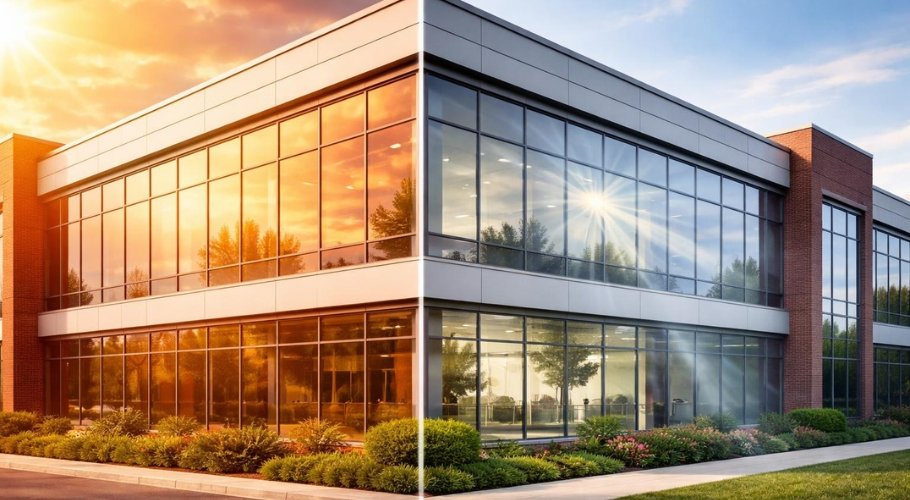
Overheated Offices and Fading Interiors How Solar Film Fixes Both in Lower Merion PA
There are two problems happening simultaneously inside Lower Merion Township’s commercial and professional spaces, and most business owners treat them as separate issues requiring separate solutions. The first is thermal — offices that become genuinely uncomfortable between noon and late afternoon, HVAC systems that cannot maintain target temperatures against sustained west-facing sun, employees who quietly relocate away from window-adjacent workstations and never return. The second is visual — flooring that has started to discolor in sun-exposed zones, upholstered furniture that fades unevenly near the glass line, displayed merchandise that loses its original color faster than the business’s replacement cycle can absorb.
These are not separate problems. They are two symptoms of the same cause: unprotected glass transmitting the full solar spectrum — infrared heat and ultraviolet radiation — directly into occupied commercial spaces throughout Lower Merion’s demanding summer season. And they share a single, non-disruptive solution that most Lower Merion business owners have not yet been offered in a conversation specific enough to make it actionable.
How Does Lower Merion’s Climate Turn Commercial Glass Into a Year-Round Business Liability
Lower Merion Township sits in Montgomery County, Pennsylvania — a jurisdiction experiencing a full mid-Atlantic climate with summers that place sustained thermal and UV demands on commercial buildings throughout the township’s most active business corridors. July average highs in the Lower Merion area consistently reach 87°F to 90°F, with heat index values regularly exceeding 95°F during the peak afternoon hours when south- and west-facing commercial glass is under maximum solar load.
UV index readings between June and August in Montgomery County reach 7 to 10 — classified as high to very high by EPA standards. These are not abstract numbers. They represent the sustained photochemical energy arriving at commercial glass surfaces throughout Lower Merion’s five-month cooling season — energy that divides into two streams the moment it hits unprotected glass. The infrared component converts to heat inside the building, driving up the cooling load and forcing HVAC systems into extended cycles. The ultraviolet component works invisibly on every interior surface it reaches — flooring finishes, fabric colors, display merchandise, and furniture upholstery — breaking down the molecular bonds that give those materials their color and structural integrity.
Both streams enter through the same glass. Both are stopped by the same solution. Understanding this dual mechanism is the foundation for understanding why solar window film is not two separate purchases for two separate problems but one installation that addresses both simultaneously.
What Does the Science of Solar Radiation Reveal About Why Both Problems Occur Together
The solar spectrum arriving at a Lower Merion commercial window consists of three distinct energy components that each behave differently once they pass through the glass.
Visible light — approximately 44% of total solar energy — is what enables occupants to see clearly without artificial lighting. This component is generally desirable and well-managed by specifying films with high Visible Light Transmission ratings.
Infrared radiation — approximately 53% of total solar energy — is the primary heat-carrying component. Standard commercial plate glass transmits the majority of this infrared energy directly into the building interior, where it converts to thermal energy that raises the air temperature in sun-exposed zones and increases the cooling load the HVAC system must overcome. This is the mechanism behind the overheated office problem that Lower Merion commercial tenants experience throughout the summer.
Ultraviolet radiation — approximately 3% of total solar energy by energy weight but disproportionately destructive by impact — is responsible for approximately 40% of all interior fading and photochemical material degradation in commercial spaces. UV radiation breaks down the chromophores — color-carrying molecular structures — in flooring finishes, fabric dyes, display materials, and painted surfaces. The damage is cumulative, invisible in real time, and irreversible without replacement. This is the mechanism behind the fading interiors problem that Lower Merion retail operators, professional offices, and hospitality businesses absorb as ongoing capital replacement costs.
Premium solar window film addresses both mechanisms in a single product layer. Infrared heat rejection at 65% to 80% Total Solar Energy Rejected directly reduces the thermal load driving overheating. UV blocking at 99% or above stops the photochemical degradation driving interior fading. Both happen simultaneously from the moment of installation.
How Do Premium Solar Films Perform Against the Specific Demands of Lower Merion’s Commercial Properties
The performance gap between entry-level and premium solar film in a Lower Merion commercial environment is wide enough to determine whether the installation actually solves the problem or merely reduces it.
Entry-level dyed solar films deliver Total Solar Energy Rejected ratings of 25% to 40%. They reduce the solar load and produce measurable improvement, but they leave the majority of infrared heat entering the building — which means the HVAC system is still fighting substantial thermal load every afternoon. More critically, dyed film pigments degrade under sustained UV exposure, producing the bronze or purple color shift that signals performance degradation. In Lower Merion’s sustained summer UV environment, this degradation becomes visible within five to eight years, at which point both the appearance and the performance of the film have declined meaningfully from original specification.
Premium nano-ceramic solar films achieve TSER ratings of 65% to 80% through ceramic particle technology that blocks specific infrared wavelengths without absorbing solar energy into degradable dye molecules. At 72% TSER on a west-facing Lower Merion office suite, the film is blocking nearly three-quarters of incoming solar energy — the difference between an office that remains comfortable through a full July afternoon and one where the thermostat battles the glass and loses. The ceramic particle structure is chemically inert and UV-stable, meaning the film that installs at 72% TSER in year one maintains that performance in year fifteen without color shift or photochemical breakdown.
Glare reduction on premium ceramic commercial films reaches 65% to 85% — directly relevant for Lower Merion’s professional service offices, medical practices, and retail environments where screen glare and visual discomfort reduce both productivity and customer experience throughout the afternoon hours.
Which Lower Merion Commercial Properties Face the Highest Combined Heat and Fading Risk
Not every commercial property in Lower Merion Township faces equal exposure to both the overheating and fading problems — and understanding which properties carry the highest combined risk guides installation prioritisation accurately.
Professional service offices along Lancaster Avenue and in the Ardmore and Wynnewood business districts with west-facing glass panels are the highest combined-risk category. These properties receive maximum afternoon solar load precisely during the hours when client-facing meetings, productivity-dependent work, and after-lunch energy management are most critical. Simultaneously, the west-facing sun exposure degrades flooring and furnishings in reception areas, conference rooms, and client-visible spaces — surfaces whose condition directly affects how the business presents to clients and partners.
Retail operations throughout Lower Merion’s commercial centers face the fading problem most acutely. Merchandise displayed in south- or west-facing window zones is exposed to both UV radiation and infrared heat throughout the business day. UV fading changes product colors and degrades packaging materials. Infrared heat creates uncomfortable browsing conditions near display areas that shortens customer dwell time. A single solar film installation addresses both the merchandise protection and the customer comfort dimension simultaneously — which is why retail adoption of commercial solar film in the Lower Merion market has been accelerating.
Medical and healthcare practices throughout the township present a specific version of the fading problem in their waiting areas and consultation rooms, where patient comfort and a calm, well-maintained interior directly influence the perceived quality of care. Flooring degradation, fabric fading on seating, and UV damage to clinical materials all accumulate under unprotected glass at the same rate they do in any other commercial space.
Is Solar Window Film the Right Investment for Solving Both Problems in a Lower Merion Property
The financial case for commercial solar film in Lower Merion Township is built on two compounding return streams that accumulate from installation day forward.
The energy cost return is immediate and measurable. Research from the Lawrence Berkeley National Laboratory on commercial building energy performance found that solar control films reduce cooling energy consumption by 10% to 30% in high-solar-load commercial environments. For a Lower Merion business spending $4,000 monthly on utilities during peak summer, a 20% cooling load reduction generates $800 per month in recoverable energy costs — sustained across every summer for the film’s ten-to-fifteen-year commercial warranty lifespan. The typical commercial installation payback period in Montgomery County falls between two and five years on energy savings alone.
The asset protection return accumulates more slowly but compounds more significantly over time. UV blocking at 99% stops flooring degradation, fabric fading, and merchandise color loss from the day of installation. For a Lower Merion retail or hospitality business whose interior replacement cycle runs $15,000 to $50,000 every seven to ten years, extending that cycle by three to five years through UV protection represents a capital deferral that comfortably exceeds the installation cost in real financial terms.
Together, these two returns make the investment case for commercial solar film in Lower Merion Township straightforward for any property owner or tenant whose building faces meaningful south or west solar exposure. Glass type compatibility must be verified before installation — particularly for the double-pane Low-E glass common in newer Lower Merion commercial construction — and this verification step should be a standard part of any professional assessment before film specification is confirmed.
Understanding which specific solar film delivers the best combined return for your Lower Merion commercial property — its glass configuration, its solar exposure, and its interior asset profile — is the conversation worth having before committing to an installation.
FAQ
Does solar window film actually stop interior fading in Lower Merion commercial spaces?
Yes — premium films block 99% of UV radiation stopping the primary cause of fading from day one.
How much can solar film reduce cooling costs in a Lower Merion office building?
Studies show 10% to 30% cooling energy reduction in high-solar-load commercial environments.
Will solar film change how a Lower Merion commercial property looks from the street?
Neutral nano-ceramic film is virtually invisible from outside with no reflective or tinted appearance.
Can solar film be installed in a Lower Merion office without disrupting business operations?
Yes — most commercial installations are complete in one day and can be scheduled outside business hours.
How long does premium commercial solar film last in Montgomery County’s climate?
Premium ceramic commercial films carry manufacturer warranties of 10 to 15 years on commercial applications.