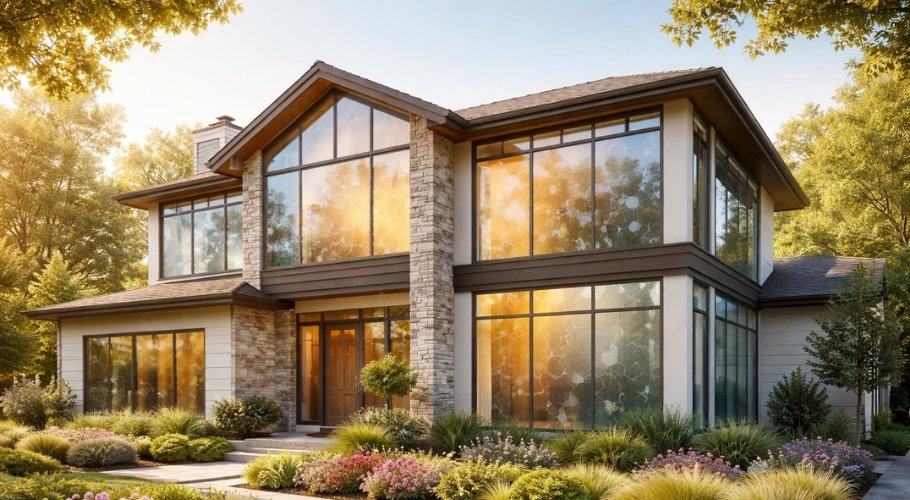
Lawrence Township Homes With Transitional Film Stay Comfortable All Day Long
Lawrence Township homeowners know this cycle well. The morning starts pleasantly enough — natural light fills the east-facing rooms, the HVAC is barely running, and the house feels exactly as it should. Then the sun shifts. By early afternoon the south-facing living room has become the room nobody wants to sit in. By 3 PM the west-facing home office is battling glare and heat simultaneously. By evening the same windows that caused problems all day feel dim and closed off as interior lights bounce back from the glass.
This is not an insulation problem. It is not an HVAC problem. It is a glass problem — and it repeats every single day across Lawrence Township’s long summer season. Standard window film addresses part of this cycle with a fixed tint that reduces the afternoon load but permanently darkens the morning and evening light that made those rooms pleasant in the first place. Transitional window film addresses the entire cycle by adapting to actual conditions rather than applying one fixed answer to a problem that changes hour by hour.
How Does Lawrence Township’s Climate Make All-Day Comfort So Difficult to Maintain
Lawrence Township sits in Mercer County, New Jersey — sharing a climate profile with neighboring Princeton, Ewing, and Trenton that delivers genuine four-season extremes. July average highs in Lawrence Township reach 86°F to 88°F, with heat index values regularly pushing past 95°F during peak afternoon hours. UV index readings between June and August consistently reach 7 to 9 — classified as high to very high — and the sustained solar intensity across Mercer County’s five-month cooling season creates a daily pattern of thermal stress that standard fixed-specification film cannot fully resolve.
The core challenge is variability. Lawrence Township mornings in summer deliver relatively tolerable solar conditions — the sun is lower, the intensity is building but not yet at its peak, and the light quality is genuinely pleasant. By midday and into the afternoon, the same windows are transmitting the full force of New Jersey’s summer solar load. By evening, the solar load has dropped again but the glass has absorbed and radiated heat throughout the afternoon, leaving rooms uncomfortably warm even as outdoor temperatures begin to ease.
A film specification optimised for the midday peak over-performs in the morning and after sunset — permanently blocking light that Lawrence Township homeowners actually want during those hours. A film specification too light for peak conditions underperforms during the most demanding afternoon hours. This is the tradeoff that transitional film is specifically engineered to eliminate.
What Science Explains How Transitional Film Adapts Where Standard Film Cannot
Standard window film applies a fixed Visible Light Transmission — VLT — to every condition the glass encounters. A film at 40% VLT transmits 40% of visible light in full July sun, on an overcast November morning, and at 9 PM when interior lights are on. The film cannot distinguish between the conditions where its blocking behaviour is needed and the conditions where it is working against the homeowner’s comfort and preferences.
Transitional window film uses a photochromic molecular structure embedded in the film’s base layer during a proprietary manufacturing process. These molecules respond dynamically to UV intensity and solar radiation striking the glass surface in real time. When solar intensity is high — during peak summer afternoon hours in Lawrence Township — the molecular structure shifts to a darker, higher-rejection configuration. When light intensity drops — in shade, on overcast days, or after sunset — the film returns to its lightest, most transparent state automatically.
The result is a film that behaves like a lightly tinted clear film when solar conditions are low and like a premium solar control film when the sun demands it. This adaptation happens continuously and passively, without any homeowner action, across every hour of every day and every season of Lawrence Township’s full climate cycle. The chemistry is stable — premium transitional films are engineered for photochromic stability across fifteen to twenty years of New Jersey UV exposure, meaning the adaptation response remains reliable throughout the film’s lifespan without the degradation that affected earlier photochromic products.
What Performance Numbers Should Lawrence Township Homeowners Expect From Transitional Film
Transitional film’s performance metrics operate across a dynamic range rather than a fixed point — which requires understanding both ends of the range and what conditions trigger each.
In its lightest state, achieved in low-light, shaded, or post-sunset conditions, transitional film maintains a Visible Light Transmission of approximately 70% to 75%. The glass feels open, naturally lit, and visually connected to the outdoors — appropriate for the Lawrence Township mornings and evenings when solar load is low and natural light quality is something worth preserving rather than filtering.
In its fully activated state, achieved under direct high-intensity UV exposure during peak summer sun, the film shifts to a Total Solar Energy Rejected rating of 60% or above in premium formulations. Infrared heat rejection in the activated state reaches 80% — directly targeting the heat-carrying component of afternoon sun that makes Lawrence Township’s south- and west-facing rooms so difficult to occupy. Glare reduction in the activated state reaches 50% to 60%, addressing the screen and eye-strain problems that accompany peak afternoon sun in home offices and living spaces throughout the township.
UV blocking at 99% or above is a fixed structural property of the film that functions regardless of which state the film occupies. Whether transitional film is in its clearest morning configuration or its fully activated afternoon state, it is continuously protecting Lawrence Township interiors — floors, furniture, artwork, and window treatments — from the photochemical degradation that UV radiation causes without producing any visible light or heat that a homeowner would notice.
Which Rooms and Orientations in a Lawrence Township Home Benefit Most From Transitional Film
Understanding which windows in a Lawrence Township home carry the daily variability that makes transitional film’s adaptation most valuable is the starting point for a well-prioritised installation.
East-facing rooms are the primary application. The east-facing breakfast area, home office, or bedroom that receives intense low-angle morning sun and transitions to comfortable ambient conditions by midday experiences exactly the daily cycle that transitional film was designed for. In the morning, the film activates to manage the direct sun. By mid-morning as conditions moderate, it shifts back toward its lighter state. By evening it is near-clear, allowing interior lighting to work naturally without the dimming that a fixed tinted film applies around the clock.
West-facing rooms are the second priority — and in Lawrence Township’s suburban residential landscape, these are often the most problematic spaces during summer afternoons. The home office that becomes unusable between 2 PM and 5 PM, the family room that heats up through the afternoon and stays warm into the evening, the kitchen with west-facing windows where cooking in summer becomes genuinely uncomfortable — all of these benefit from transitional film’s activation during peak west-sun hours and its return to a lighter state as the sun sets.
South-facing glass with variable shade conditions is the third application. Lawrence Township properties with mature trees, covered porches, or architectural overhangs that shade south-facing windows during part of the day benefit from a film that adapts to actual exposure rather than applying fixed performance to conditions that change significantly across the hours.
North-facing glass does not benefit from transitional film’s photochromic adaptation because it receives no direct solar radiation to trigger activation. Standard clear Low-E insulating film is the appropriate specification for north-facing glass in Lawrence Township regardless of season.
Is Transitional Window Film the Right Long-Term Investment for a Lawrence Township Home
The investment case for transitional film in a Lawrence Township home comes down to whether the specific rooms and orientations being treated experience the kind of daily and seasonal light variability that makes the film’s adaptation advantage meaningful in practice.
For Lawrence Township homes where east- and west-facing rooms are genuinely used throughout the day — where the morning experience of natural light matters as much as the afternoon experience of solar control — transitional film delivers something no fixed-specification film can: the right performance for each moment rather than a permanent compromise between competing needs. A standard ceramic solar control film at 65% TSER is an excellent specification for a south-facing Lawrence Township room with consistent direct sun. The same film on an east-facing room that needs solar control at 8 AM and maximum light transmission at 8 PM is solving half the problem while creating the other half.
Glass type compatibility is a necessary pre-installation step for any Lawrence Township home, particularly those built after 1990 with double-pane Low-E glass. Transitional film’s activated state creates a higher solar absorption condition than its light state, and compatibility with sealed insulated glass units must be verified before installation. Any professional installer working in Mercer County should confirm glass configuration before recommending a transitional film specification.
The premium cost of transitional film over standard solar control reflects its engineering sophistication and the genuine performance advantage it delivers on variable-condition glass. Over a fifteen-to-twenty-year lifespan in Lawrence Township’s demanding four-season climate, that premium is recovered through consistent year-round comfort that no fixed specification can match on the windows where daily variability is the actual condition being managed. Speaking with a local window film specialist who understands Mercer County’s housing stock and climate is the most direct path to confirming whether transitional film is the right specification for your specific Lawrence Township property.
FAQ
Does transitional window film work on double-pane glass in Lawrence Township homes?
Compatibility must be verified for Low-E sealed units before installation is confirmed.
How quickly does transitional film shift between its light and dark states?
Activation occurs within minutes of direct UV exposure reaching the film surface.
Will transitional film make Lawrence Township rooms too dark on overcast days or at night?
No — in its light state the film maintains 70 to 75 percent VLT keeping rooms naturally bright.
Does transitional film still block UV rays when it is in its lightest clear state?
Yes — 99 percent UV blocking is a fixed structural property independent of activation level.
Is transitional window film worth the higher cost compared to standard solar film in NJ?
Yes for homes with genuine daily light variability — east and west-facing rooms benefit most.