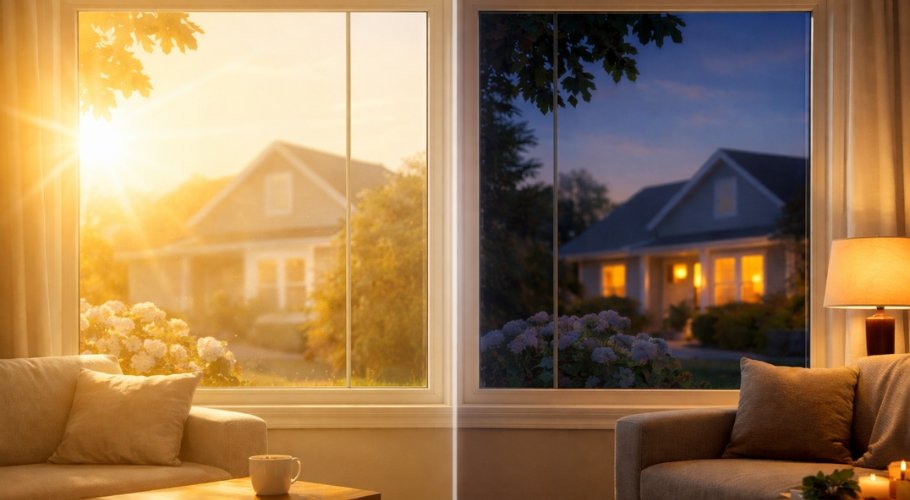
Too Bright in the Morning Too Dark at Night How Transitional Film Fixes Both
There is a specific frustration that east-facing glass produces in South Jersey homes that is entirely different from the general summer heat complaint. It is not seasonal. It is daily. Every morning, the sun clears the horizon and enters at a low, penetrating angle — and for two to three hours, the room becomes difficult to inhabit. Screens become unreadable. Eyes strain against the harsh contrast. The space designed to feel open and welcoming becomes the one room everyone avoids until mid-morning.
The evening arrives, and the problem reverses. The same windows that were too bright at 8 AM feel closed off and dim by 8 PM. Interior lighting bounces back from the glass. The view disappears. Standard solar control film addresses the morning half of this problem with a fixed tint — but permanently darkens the evening in the process. That is not a solution. It is a tradeoff. Transitional window film eliminates the tradeoff entirely.
How Does South Jersey’s Climate Make This Light Problem Worse Than Most Homeowners Expect
Burlington County and Camden County homeowners live with one of the most demanding light variability profiles in the mid-Atlantic region. July heat index values regularly reach 95°F to 98°F, with UV index readings between June and August consistently ranging from 7 to 10 — classified as high to very high by EPA standards. Those same homes face December UV readings of just 1 to 2, when every bit of available winter daylight matters.
Within a single day, a South Jersey home cycles from intense low-angle morning sun through high midday solar load to gentler evening ambient light. A standard fixed-specification film optimised for the summer peak applies that same blocking behaviour across every moment — reducing evening light you want just as aggressively as it blocks the heat you do not want at noon. The climate variability of South Jersey is exactly why a fixed film specification is always a compromise here, and why an adaptive solution exists for precisely this region and condition.
What Science Explains Why Standard Window Film Cannot Solve Both Problems at Once
The physics behind the morning-brightness and evening-darkness problem is straightforward. Visible Light Transmission — VLT — measures the percentage of visible light a film allows through the glass. A standard solar control film at 35% VLT delivers that fixed transmission in full sun, in shade, in summer, and in winter. It cannot distinguish between the harsh 8 AM direct sun you want blocked and the soft 8 PM ambient light you want preserved. The same specification that reduces morning glare by 65% reduces evening light transmission by exactly the same amount.
Standard glass transmits up to 75% of total solar energy including infrared heat, ultraviolet radiation, and visible light simultaneously. Films that manage this through fixed absorption or fixed reflection cannot selectively target the morning solar load while releasing their restriction at night. The molecular structure of standard film does not respond to changing light conditions. It applies one answer to every question the sun asks — and South Jersey’s daily and seasonal variability asks fundamentally different questions at different hours and across different months.
How Does Transitional Window Film Actually Adapt to South Jersey’s Changing Light Conditions
Transitional window film — also called photochromic film — uses a proprietary manufacturing process to embed light-sensitive molecular structures into the film’s base layer. These structures respond dynamically to UV intensity and solar radiation striking the glass surface in real time.
When solar intensity is high — during a direct-sun morning or peak-summer afternoon in Cherry Hill, Mount Laurel, or Princeton — the molecular structure shifts state, moving from a lighter baseline to a darker, higher-rejection configuration. When light intensity drops — in shade, on overcast days, or after sunset — the film returns to its clearest, most transparent state automatically without any homeowner action required.
This is the world’s only stable photochromic window film technology. Premium transitional films achieve Total Solar Energy Rejected ratings of 60% or above in their activated state, glare reduction of 50% to 60% during peak sun, and 80% infrared heat rejection when fully activated — while maintaining a Visible Light Transmission of 70% to 75% in their light state after sunset. UV blocking at 99% or more is a fixed structural property of the film that functions regardless of which state the film occupies at any moment. The Film Expert section at Window Film Guy covers photochromic technology and UV stability in technical depth for homeowners who want the full scientific picture. You can also review common performance questions on the FAQ page.
Which South Jersey Rooms Benefit Most From Transitional Film and Why
Understanding which windows to prioritise transforms transitional film from a general upgrade into a targeted, high-return installation for South Jersey properties.
East-facing glass is the primary application. The morning-peak-to-evening-ambient cycle is most acute here. Transitional film shifts from high-performance solar control during morning direct sun to near-clear configuration by evening — directly addressing both extremes of the daily cycle in a single product. This is where the too-bright morning and too-dark evening problems exist simultaneously and are solved simultaneously.
West-facing glass benefits from the afternoon activation response. The film darkens as afternoon sun intensifies across South Jersey’s peak summer hours and brightens as sunset transitions to evening ambient light. For Mount Laurel, Voorhees, and Cherry Hill homeowners whose west-facing rooms are uncomfortably warm in the afternoon but used for evening activities after sunset, this transition preserves the evening usability that a standard high-rejection fixed film permanently removes.
South-facing glass with variable shade is the third priority. Properties where south-facing windows receive direct sun during part of the day and shade from trees or overhangs during other parts benefit from adaptive specification. A standard solar film on partially shaded south-facing glass is either under-performing in full-sun periods or over-darkening in shaded periods. Transitional film reads actual conditions and responds accordingly. The Local Tinting Guides section provides orientation-specific guidance for South Jersey homes that supports this prioritisation decision.
North-facing glass does not benefit from transitional film’s adaptation because there is no direct solar load to trigger activation at any point during the year. Standard Low-E insulating film is the appropriate north-facing specification for South Jersey homes regardless of season.
Is Transitional Window Film the Right Long-Term Investment for Your South Jersey Home
The comparison between transitional and standard solar control film ultimately comes down to matching the product to the actual conditions the glass experiences — not to the worst-case peak condition alone.
Standard nano-ceramic solar control film at 65% TSER is an excellent, well-proven specification for south-facing South Jersey glass that receives consistent direct sun from morning through mid-afternoon with little variability. The fixed specification is well-matched because the conditions are consistent. For a Burlington County home with ceramic film already installed on consistent-sun south-facing glass, that choice may remain entirely appropriate.
Where transitional film earns its premium is on glass with genuine daily variability — east-facing rooms that need strong solar control at 8 AM and maximum light transmission at 8 PM, west-facing rooms that need afternoon heat rejection and evening openness, and south-facing glass that alternates between direct sun and shade throughout the day. Understanding whether TSER numbers alone predict real-world performance in these variable conditions is exactly the kind of distinction covered in the TSER myth article on this site.
Transitional film carries a higher material cost than standard solar control. Over a fifteen-to-twenty-year lifespan in South Jersey’s demanding four-season climate, that premium is recovered through consistent year-round performance that no fixed specification can match on variable-condition glass. Glass type compatibility — particularly for double-pane Low-E units common in newer South Jersey construction — must be verified before installation. The Princeton pre-install guide covers this compatibility question in detail and applies directly to any South Jersey property with modern glass.
To understand whether transitional film is the right specification for your specific property — its orientation, glass type, and daily comfort challenges — speaking with a local specialist who knows Burlington and Camden County residential conditions is the most direct path to a well-matched answer. The Contact Us page connects you with that conversation directly.
FAQ
Does transitional window film work on double-pane glass in South Jersey homes?
Requires a professional compatibility check for Low-E sealed units before installation is confirmed.
How fast does the transitional film shift states when direct sun hits the glass?
Activation occurs within minutes of direct UV exposure reaching the film surface.
Will the transitional film make rooms too dim on cloudy days or in the evening?
No — in its light state, the film maintains 70–75% VLT, keeping rooms naturally bright.
Does the transitional film block UV rays when it is in its lightest, clear state?
Yes — 99% UV blocking is a fixed structural property independent of the film’s activation level.
Is transitional window film worth the higher cost compared to standard solar film?
Yes, for homes with high daily light variability, east and west-facing rooms benefit most clearly.