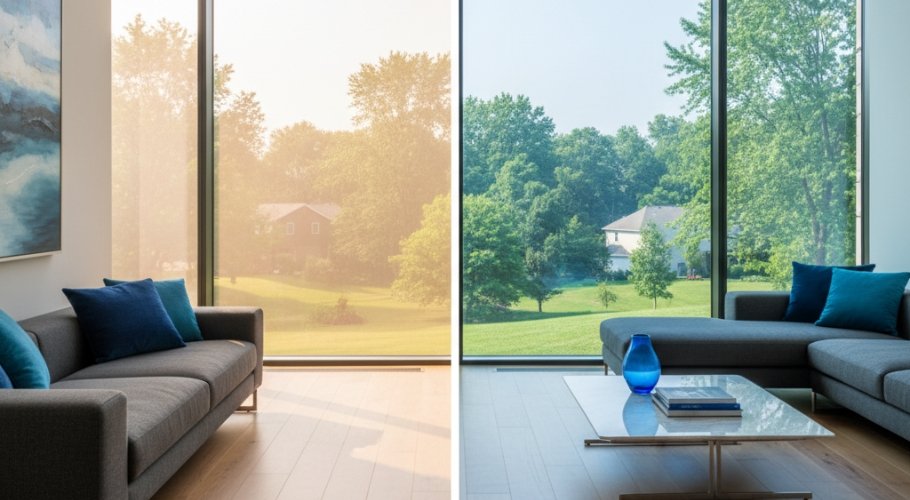
Are Cherry Hill Businesses Losing Money Through Untreated Storefront Glass?
What every Cherry Hill business owner needs to understand about the real cost of unprotected commercial glass — and what a single upgrade can change.
Walk down any commercial corridor in Cherry Hill — Haddonfield Road, Route 70, Marlton Pike — and you’ll notice something consistent. Storefronts with large, untreated glass panels. Retail shops where merchandise sits directly in the sun’s path. Offices where employees have repositioned their desks away from windows. Restaurants where window-side tables go empty on sunny afternoons because guests find them unbearable.
None of these businesses set out to create uncomfortable, energy-inefficient spaces. But untreated storefront glass is quietly doing exactly that — and in Cherry Hill’s competitive commercial environment, the financial consequences are more significant than most owners recognize.
Cherry Hill’s Commercial Climate: What the Numbers Say
Cherry Hill sits in Camden County in South Jersey, experiencing a full mid-Atlantic climate with summers that are consistently hot, humid, and solar-intense. July average highs reach 86°F to 88°F, with heat index values frequently pushing past 95°F during peak afternoon hours. UV index readings between June and August regularly reach 7 to 10 — classified as high to very high by EPA standards.
For a commercial property, these aren’t just comfort statistics. They translate directly into operating costs.
The US Department of Energy estimates that solar heat gain through windows accounts for approximately 40% of cooling load in commercial buildings. In a Cherry Hill retail space or office with large south- or west-facing glass panels — which describes the majority of commercial storefronts along Route 70 and Marlton Pike — the HVAC system is fighting that solar load every afternoon from May through September. That’s five months of elevated energy consumption, driven in large part by untreated glass.
A 2024 Lawrence Berkeley National Laboratory study on commercial building energy performance found that solar control window films applied to existing glass can reduce cooling energy consumption by 10% to 30% in high-solar-load commercial environments. For a mid-sized Cherry Hill retail or office space spending $2,000 to $4,000 monthly on utilities during peak summer, that reduction represents real, recurring savings.
The Three Ways Untreated Glass Costs Cherry Hill Businesses Money
Understanding the financial impact requires breaking it down into three distinct categories — each of which affects a different line on the business’s financial statement.
Energy costs — the most visible and immediate loss. Untreated commercial glass offers almost no resistance to solar heat gain. Standard plate glass transmits up to 87% of solar infrared radiation directly into the interior. Every HVAC unit cycling harder and longer to maintain comfortable temperatures is a direct consequence. In Cherry Hill’s summer climate, this isn’t a marginal difference — it’s a sustained daily load across the hottest months of the year.
Merchandise, fixtures, and interior asset degradation — the slow, invisible loss. Ultraviolet radiation is responsible for 40% of fading and material degradation in commercial interiors. For a Cherry Hill retailer displaying apparel, furniture, consumer electronics, or any product with color-sensitive packaging, south- or west-facing window exposure without UV protection is a continuous depreciation engine. Merchandise that fades, discolors, or degrades before sale is direct inventory loss. Flooring, fixtures, and display units that age prematurely increase capital replacement costs.
Customer and employee comfort — the hardest to quantify but very real loss. A retail customer who is uncomfortably hot near the entrance or window-side display area spends less time browsing and converts at a lower rate. A restaurant diner who avoids the window table entirely is lost revenue on that seat. An office employee repositioning away from glare loses productive workspace. These behavioral adjustments accumulate over time into measurable business impact — reduced dwell time, lower conversion, lower productivity — none of which show up on an energy bill but all of which affect the bottom line.
What Commercial Window Film Actually Addresses
Premium commercial window film applied to storefront and interior glass operates on three simultaneous performance dimensions.
Solar heat rejection is measured by Total Solar Energy Rejected, or TSER. Quality commercial films achieve TSER ratings between 55% and 80%, meaning they block the majority of the sun’s combined solar energy before it enters the building. This directly reduces cooling load, allowing HVAC systems to maintain target temperatures more efficiently. In practical terms, rooms and retail floors near glass panels become consistently comfortable rather than variably brutal depending on sun angle and time of day.
UV blocking is a separate but equally important metric. Premium films block 99% or more of ultraviolet radiation regardless of their tint level or visible light transmission. This means even films that maintain a nearly clear, customer-facing appearance still provide near-total protection against the UV damage destroying merchandise, flooring, and fixtures. A Cherry Hill retailer can protect display inventory without darkening the store or reducing visual appeal from the street.
Glare reduction is particularly relevant for commercial environments. High-performance films reduce visible glare by 60% to 80%. For office spaces along Route 70 or Marlton Pike where employees work at screens, or for restaurants where window-side dining should be an asset rather than an obstacle, this reduction transforms how those spaces function throughout the day.
Storefront-Specific Considerations for Cherry Hill Commercial Properties
Visibility and brand appearance matter. Unlike residential applications where exterior appearance is a personal preference, commercial storefronts have a business interest in maintaining visual clarity and brand presentation. The good news is that modern spectrally selective and nano-ceramic films are designed precisely for this balance — high solar performance with minimal change to visible light transmission and exterior appearance. A well-selected commercial film is effectively invisible to a customer walking past while performing significant thermal and UV work on the glass.
One-way vision and perforated films serve a different commercial purpose. Cherry Hill businesses that want to use window space for advertising while maintaining privacy from the street — particularly retail preparation phases, dental and medical offices, financial services — can use perforated or one-way vision films that print custom graphics on the exterior while preserving interior sightlines. This turns dead glass square footage into productive signage real estate.
Security film addresses a specific vulnerability. Ground-floor commercial glass is a point of physical vulnerability. Anti-smash-and-grab security films, available in multiple thicknesses, hold glass together under impact — slowing forced entry, reducing glass-related injury risk, and deterring opportunistic theft. For Cherry Hill retail and financial businesses, this is a meaningful risk mitigation layered onto an already-useful glass upgrade.
Low-E film extends the value into winter. Cherry Hill’s January average lows reach the mid-20s°F. Commercial spaces with large glass facades lose significant heat through the glass during winter months. Low-emissivity film reflects interior heat back into the space, reducing heating load and providing year-round energy performance — not just a summer upgrade.
The ROI Calculation Cherry Hill Business Owners Should Run
Window film is not an operating expense. It is a capital improvement with a measurable return.
The installed cost of commercial window film varies by glass area, film specification, and building complexity, but typical commercial installations recover their cost in energy savings alone within two to five years. When merchandise protection, reduced HVAC wear, and improved customer and employee experience are factored in, the effective payback period compresses further.
Premium commercial films carry manufacturer warranties of 10 to 15 years on most commercial applications. That means a single installation decision made today continues performing — and continues generating savings — for well over a decade.
For a Cherry Hill business operating on the margins typical of retail or food service, an upgrade that simultaneously reduces utility costs, protects inventory, and improves the comfort of the space for both customers and staff is genuinely difficult to find elsewhere at comparable cost.
What to Do Before You Install
Verify glass compatibility. Double-pane and Low-E glass configurations require specific film selections to avoid thermal stress issues. Any commercial installer should assess your existing glass before recommending a film specification.
Understand what you’re solving for first. Energy cost reduction, merchandise protection, glare control, security, and signage are all valid primary objectives — and they lead to different film recommendations. Knowing your priority helps ensure you select the right product for your specific situation.
Consider phasing by solar exposure. If budget requires prioritizing, south- and west-facing storefront glass delivers the highest return on commercial film investment in Cherry Hill’s climate. North-facing glass can follow.
To understand which specific film type delivers the best return for your Cherry Hill commercial property — whether you’re on Route 70, Haddonfield Road, or anywhere across Camden County — speaking with a window film specialist who understands South Jersey’s commercial environment is the most efficient path forward.