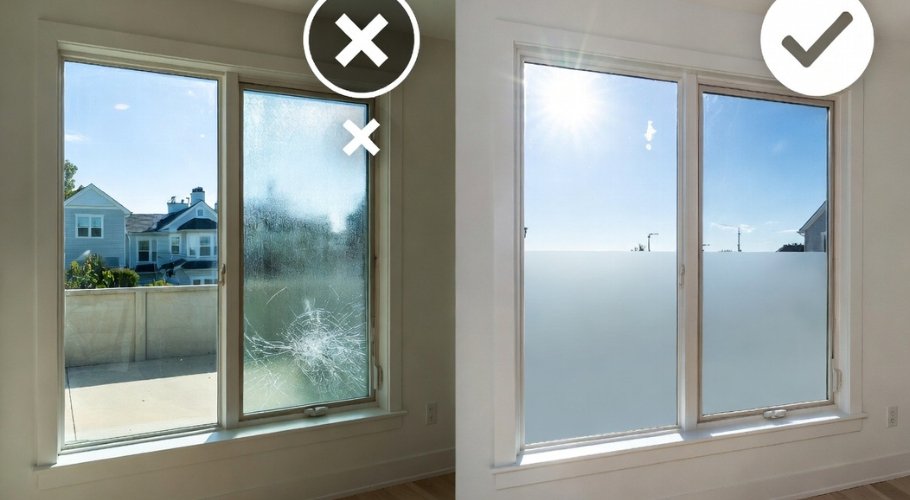
Thermal Shock 101: Why You Can’t Just Put Any Film on Princeton Dual-Pane Windows.
There’s a specific kind of expensive mistake that Princeton homeowners make every year. It happens after a renovation, after a window replacement, or after finally deciding the afternoon sun on the back of the house has become unbearable. Someone calls an installer — or buys a film kit online — and applies a window treatment to their dual-pane insulated glass without asking a single question about compatibility. The film goes on cleanly. The room gets darker. And then, somewhere between six months and two years later, the glass between the panes goes foggy. Or a hairline crack appears along the edge of a panel. Or the window manufacturer’s warranty notice arrives, voided.
The film wasn’t defective. The installer may have been perfectly competent. The problem was the choice of film — and the failure to understand what dual-pane windows actually are, how they fail, and what types of solar film are and aren’t safe to apply to them.
In Princeton, where the median home value approaches and frequently exceeds $850,000 and where a significant portion of the housing stock now features modern Energy Star-certified dual-pane windows with Low-E coatings and argon or krypton gas fills, this compatibility question is not an academic one. Getting it wrong means replacing an insulated glass unit — a repair that typically runs $200 to $800 per window — or, in cases involving larger decorative panels or architectural glass, considerably more.
What a Dual-Pane Window Actually Is — and Why It’s Vulnerable
To understand the thermal shock risk, you first need to understand the structure of an insulated glass unit, or IGU — the technical term for what most homeowners call a dual-pane or double-pane window.
An IGU consists of two or three panes of glass separated by a spacer system, typically containing a desiccant material, with the entire assembly hermetically sealed at the edges using a two-part polymer seal system. The space between the panes — typically 1/2 to 3/4 of an inch — is filled with an inert gas, usually argon or krypton, selected for its low thermal conductivity. That gas fill is what gives the IGU its insulating performance. Most modern units in Princeton homes also carry a Low-E coating: a microscopically thin, transparent metallic layer applied to one of the interior glass surfaces during manufacturing that reflects infrared radiation and controls radiant heat transfer across the air gap.
The result is a window assembly that, when functioning correctly, represents a sophisticated thermal barrier. A high-quality dual-pane Low-E window with argon fill can achieve a U-factor as low as 0.20–0.30 — far better than conventional single-pane glass, which typically sits around 1.0. That performance differential is why Princeton homeowners who replaced older windows with Energy Star certified units saw measurable drops in their PSEG bills and why newer construction in the borough defaults to these specifications as a code baseline.
But here’s the critical vulnerability: the edge seal system is the weakest point of the entire assembly. Both temperature fluctuation and mechanical stress degrade it over time. Research from the National Renewable Energy Laboratory identifies temperature and pressure fluctuations as primary mechanical stressors on IGU edge seals — fluctuations that cause the glass panes to expand and contract cyclically, softening and weakening the seal material. Sunlight is described as the most important aging factor on IGUs due to its thermal and photochemical effects on the edge seal.
What happens when the wrong window film concentrates additional heat into that glass? The failure mode accelerates significantly.
The Thermal Stress Fracture: When Film Creates Heat the Glass Wasn’t Designed to Handle
Here’s the mechanism behind thermal shock as it applies to window film, explained plainly.
Solar radiation hits a window and is either transmitted through the glass, reflected from the surface, or absorbed into the glass itself. The proportion of energy that gets absorbed — rather than transmitted or reflected — is what drives glass temperature. Standard clear glass absorbs a modest portion of incoming solar energy. Most of the heat passes through as transmitted radiation.
Certain window films change that equation substantially. Dark tinted films, highly absorptive security films, and some older-generation solar films absorb solar energy themselves — which is how they reduce heat transmission into the room. The problem is that the absorbed energy has to go somewhere, and it goes into the glass as heat. The glass temperature rises, often dramatically, relative to the cooler unfilmed portions of the same pane.
Here’s where thermal stress fracture begins. The center of the glass pane — where sunlight is most intense and the absorptive film is working hardest — heats up. The edges of the same pane, shaded by the window frame, remain relatively cool. The temperature differential across a single pane can reach 30, 40, or even 50 degrees Fahrenheit in peak summer conditions. Glass under thermal stress expands where it’s hot and remains fixed where it’s cool, creating tensile stress at the glass edges — exactly where the IGU’s seals already represent a structural vulnerability. In a single-pane window, this may cause a stress crack but nothing more costly. In an IGU, the same thermal differential stresses the seal, can cause inter-pane gas expansion, and in cases of larger panes or pre-existing micro-defects, can cause edge cracking that compromises the entire unit.
Industry professionals track this using a metric called the Thermal Stress Factor, or TSF, which measures how much heat a given film causes a window to absorb relative to untreated glass. A film with a high TSF value is generating substantial additional heat load on the glass — and on Princeton homes with large south- and west-facing windows that already see intense afternoon sun during Mercer County summers, that additional heat load is not trivial.
The Low-E Conflict: When Film Meets Factory Coating
The thermal stress issue is compounded for Princeton homeowners whose windows carry Low-E coatings — which, for any home built or renovated with replacement windows in the last two decades, is most of them.
Low-E coatings are applied during manufacturing to one of the interior glass surfaces within the IGU. Their position — which side of which pane — varies based on the window’s design intent: some configurations are optimized for summer heat rejection, others for winter heat retention, and some for both. The specific surface location of the Low-E coating determines how it interacts with any aftermarket film applied to the interior glass surface.
This interaction can be problematic in several ways. First, applying a heat-absorptive film over glass that already carries a Low-E coating changes the thermal performance equation of the entire unit. The Low-E coating was engineered to reflect infrared radiation from a specific surface, in a specific direction, under the assumption that only standard glass sits between it and the room interior. Add a film layer that absorbs some of that infrared energy, converts it to heat, and re-radiates it into the inter-pane space, and the thermal dynamics the manufacturer modeled are no longer accurate.
Second, some film adhesive formulations are chemically incompatible with specific Low-E coating types — particularly soft-coat Low-E, where the metallic layer sits on an accessible interior glass surface rather than being sealed within the cavity. Contact between an incompatible adhesive and a soft-coat Low-E surface can degrade the coating over time, reducing its infrared reflectivity and diminishing the window’s long-term insulating performance.
Third, and most practically: many window manufacturers explicitly state in their warranty documentation that applying unapproved aftermarket window film to their products voids the glass warranty. For Princeton homeowners who paid premium prices for high-performance window systems — often $800 to $1,500 per installed window for quality Energy Star units — discovering that a tint job has voided that warranty is a significant financial and logistical problem.
What Films Are Safe — and the Compatibility Metrics That Matter
None of the above means window film can’t be applied safely to dual-pane windows. Tens of thousands of IGU installations receive compatible film every year without incident. The key is understanding which film characteristics determine compatibility, and why.
The primary safety metric for IGU film compatibility is the Solar Heat Gain Coefficient, or SHGC, of the combined glass-and-film system. Films with high heat absorption change the SHGC of the window in ways that may exceed the glass manufacturer’s tested limits for safe thermal performance. Films with low heat absorption — because they reflect rather than absorb solar energy — maintain glass temperatures close to untreated baselines and impose minimal additional thermal stress.
This is precisely why spectrally selective ceramic films represent the correct specification for dual-pane windows in Princeton homes. Ceramic films achieve their heat rejection through a fundamentally different mechanism than absorptive films: rather than absorbing infrared radiation and converting it to glass heat, they reflect it at the nano-particle level, using non-conductive ceramic particles engineered to intercept specific wavelengths. Because these films are low-absorption by design, they add minimal heat load to the glass itself, keeping glass temperatures — and inter-pane thermal stress — well within safe operating ranges for standard IGU assemblies.
The practical consequence: a well-specified ceramic film can block 50–65% of total solar energy entering a Princeton home through its dual-pane windows while generating heat absorption levels that most window manufacturers explicitly approve for use with their IGU products. Many film manufacturers publish compatibility charts that cross-reference film TSF values against glass specifications, allowing a knowledgeable installer to confirm safe pairing before any film touches a window.
Spectrally selective films — a category that includes premium ceramic products — maintain high visible light transmission while achieving meaningful heat and UV rejection through reflective rather than absorptive mechanisms. This combination is particularly valuable for Princeton homeowners who want to preserve the quality of natural light in their interiors while protecting the investment represented by their high-performance window systems.
The Low-E Addition Question: Does Princeton Already Have Enough?
A reasonable question from Princeton homeowners who’ve already invested in Energy Star Low-E dual-pane windows: if the windows already have Low-E coatings, do they actually need additional film?
The answer depends on what the window was engineered to address — and what it wasn’t.
New Jersey sits in the mixed climate zone (IECC Zone 4–5), and windows specified for this zone balance summer heat rejection against winter solar gain retention. The SHGC and U-factor combination that qualifies a window for Energy Star certification in this zone is optimized for average annual performance across both seasons — not peak summer performance on a southwest-facing Princeton home office wall in late July.
Additionally, Low-E coatings within an IGU don’t block UV radiation from reaching interior surfaces with anywhere near the efficiency that a dedicated UV film achieves. Standard Low-E glass typically blocks around 40–60% of incoming UV. A quality UV window film blocks 99%. For Princeton homeowners protecting original hardwood floors, antique furnishings, artwork, or valuable textiles, the gap between those two numbers represents real material degradation over time.
What a compatible spectrally selective film adds to a Low-E IGU isn’t redundancy — it’s additional precision. It can push summer heat rejection beyond what the factory window specification achieves, provide superior UV blockage, and target the specific orientations and rooms in a Princeton home where solar load is most intense without any of the thermal stress risks associated with absorptive film products. The key is ensuring the film selected is rated compatible with the specific Low-E configuration of the installed windows — which requires knowing the window manufacturer, the Low-E surface position, and the film’s published TSF values.
A Practical Pre-Installation Checklist for Princeton Homeowners
Before authorizing any window film installation on dual-pane windows in your Princeton home, the following steps protect both your investment and your window warranty:
Identify your window manufacturer and model. Most window sashes carry a small label — often on the spacer bar visible at the edge of the glass — listing the manufacturer and often the glass configuration. This information allows an installer to cross-reference film compatibility against the manufacturer’s published guidelines.
Confirm the Low-E surface position. Whether your Low-E coating is on surface #2 (inner face of the outer pane) or surface #3 (inner face of the inner pane) determines which films are compatible from an adhesive-contact standpoint. A qualified installer will assess this before specifying film.
Request the film’s TSF value and IGU compatibility documentation. Any professional-grade film product will carry published TSF data. Your installer should be able to confirm that the film’s thermal stress impact falls within the range your window manufacturer approves for use with their IGUs.
Review your window warranty documentation. Many manufacturers specify that film must be installed by certified professionals using approved products to maintain warranty validity. Knowing the terms before installation is the difference between a protected upgrade and an inadvertent warranty void.
Prioritize reflective over absorptive film categories. This is the single most important film-selection principle for dual-pane windows. Ceramic and spectrally selective films that reject heat through reflection impose minimal thermal stress on glass. Highly absorptive films — particularly dark security films and some older carbon and dyed products — carry elevated IGU risk on the wrong windows.
To get a compatibility assessment that’s specific to the windows in your Princeton home, consider speaking with a local window film specialist who understands both IGU engineering and the particular window systems common in Mercer County properties. The right specialist will ask about your windows before recommending a film — not after.
Conclusion
Dual-pane windows represent one of the most meaningful energy and comfort investments a Princeton homeowner can make. The argon fill, the Low-E coating, the precision-engineered seal system — each of these elements contributes to a window assembly that, when functioning correctly, earns its cost over a multi-decade service life.
Window film, applied correctly and specified with IGU compatibility as the starting point, can enhance that investment — extending UV protection beyond what the factory coating delivers, targeting summer heat reduction in the specific rooms where solar load is most intense, and doing all of this without imposing thermal stress that accelerates seal degradation.
Applied incorrectly — with the wrong film on the wrong glass, by an installer who didn’t ask the right questions before starting — it can void a warranty, stress a seal, and turn a $1,000 window into a fogged, failed unit that needs replacement within a few years.
In Princeton, where the windows matter and the homes are worth protecting, the distinction between those two outcomes comes down entirely to what film you choose and whether the person choosing it understood the glass it was going on.