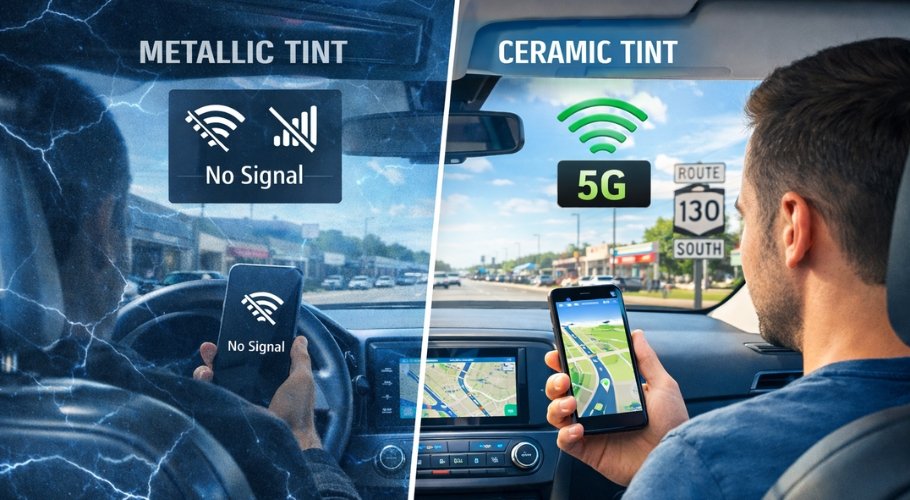
5G, GPS, and Your Tint: Why Metalized Films are a Thing of the Past.
You’ve just had your windows tinted. The car looks sharp, the heat rejection is noticeable, and you pull out of the parking lot feeling good about the upgrade. Then you open Google Maps on Route 130 heading toward Cinnaminson and watch the blue dot freeze, spin, and recalculate three times before you’ve made a single turn. Your phone shows full bars, but call quality on your hands-free drops the moment someone walks near your car door. Your E-ZPass transponder misses a toll.
None of this is a coincidence. It’s physics — and it’s a completely predictable consequence of choosing the wrong type of window film for a vehicle that runs on wireless signals as much as it runs on fuel.
South Jersey drivers are increasingly running into this problem as vehicles become more technology-dependent and 5G networks roll out across Burlington, Camden, and Mercer counties. And the cause almost always traces back to one thing: metalized window film applied to glass that contains embedded antennas, sensor arrays, or transponder windows.
The Science Behind Why Metal and Wireless Signals Don’t Mix
To understand the problem, you need to understand what’s actually embedded in modern window film — and what that structure does to electromagnetic waves.
Metalized window films are constructed with a layer of microscopic metal particles — typically aluminum, titanium, or copper compounds — suspended within the film’s polyester matrix. These particles are what give metalized film its reflective, slightly mirrored appearance, and they are genuinely effective at reflecting solar heat away from the glass. That performance characteristic is real.
The problem is that metal reflects and absorbs electromagnetic waves regardless of their source. GPS, mobile networks (4G/5G), Bluetooth, and radio signals all rely on electromagnetic waves to transmit data — and metallic films create a partial Faraday cage effect around the vehicle cabin, reflecting or absorbing those signals along with the solar radiation they’re designed to block.
A Faraday cage is a conductive enclosure that attenuates electromagnetic fields inside it — the same principle that makes your signal disappear inside an elevator with metal walls or a steel-framed parking structure. Your vehicle’s metal body already creates a partial version of this effect. Add metalized film to the glass — the only non-metal surface in the cabin — and you’ve substantially completed the cage. Every wireless signal trying to enter or exit your vehicle now has to penetrate a conductive barrier it wasn’t designed to cross.
Signal reduction varies based on metal type, particle density, and the number of windows covered, with GPS navigation systems suffering the most because satellite signals are weaker than cellular signals and therefore more easily disrupted. Cell phones, Bluetooth, keyless entry fobs, toll transponders, and satellite radio all experience measurable interference — but GPS takes the hardest hit because the signal originates from satellites in orbit and arrives at your windshield already weakened by 12,500 miles of atmosphere.
Why 5G Makes This Problem Significantly Worse
For drivers who tolerated minor GPS lag with older 4G-era metalized film, upgrading to a 5G-capable phone or vehicle is making the interference dramatically more noticeable — and there’s a straightforward reason why.
5G cellular signals operate at higher frequencies than 4G LTE, and higher-frequency waves are more susceptible to obstruction by conductive materials. Metallic film can reduce 5G reception more noticeably than older cellular standards — meaning drivers with 5G-capable phones should avoid metallic film entirely.
This frequency sensitivity is a fundamental property of electromagnetic physics. Higher-frequency waves carry more data but are more easily blocked, reflected, or absorbed by conductive surfaces. The millimeter-wave spectrum used by high-band 5G — which delivers the fastest speeds and lowest latency — is particularly vulnerable, with even modest conductive barriers causing dramatic signal degradation.
New Jersey has strong 5G deployment, with T-Mobile’s 5G reaching over 91% of the state and AT&T’s 5G footprint covering over 80% — including the South Jersey corridors of Burlington County, Camden County, and the Route 1 corridor through Mercer County where Princeton and Trenton anchor dense connectivity infrastructure. Drivers in these areas are increasingly accessing genuine high-speed 5G — and increasingly discovering that their metalized window film is throttling the performance they’re paying their carrier for.
The irony is that South Jersey’s expanding 5G coverage, which should be a benefit to drivers in the region, becomes a liability for anyone who installed metalized tint before understanding the interference problem. The better the network around you, the more frustrating it is to sit inside a partial Faraday cage while your phone struggles to maintain the connection that’s technically available.
The Modern Vehicle: A Signal-Dependent Machine
A decade ago, “the car’s electronics” meant the radio, the clock, and maybe a backup camera. That description no longer applies to anything manufactured in the past several years — and it certainly doesn’t apply to the vehicles most South Jersey commuters are driving across Burlington County today.
Modern vehicles are wireless-dependent systems in ways that were unimaginable when metalized window film was the industry standard. Consider what’s actually running on RF signals in a typical 2022–2026 vehicle:
Embedded GPS and navigation systems receive satellite signals through the windshield and rear glass. If those windows carry metalized film, signal acquisition slows, positioning accuracy degrades, and the navigation struggles to maintain a reliable lock — especially in areas where the satellite geometry is partially obstructed by terrain or buildings.
Cellular connectivity handles everything from over-the-air software updates (standard on virtually all EVs and many hybrids) to emergency SOS systems, remote start apps, and real-time traffic data. For electric vehicles like Tesla, signal blockage from metallic film could disrupt critical over-the-air software upgrades, which are delivered wirelessly and are essential to vehicle performance and safety.
ADAS sensor systems — advanced driver assistance systems including lane departure warning, automatic emergency braking, and adaptive cruise control — often rely on radar and lidar arrays mounted behind or near glass surfaces. While these systems typically use frequencies that differ from cellular bands, metalized film applied near sensor locations can interfere with calibration and performance.
Keyless entry and push-button start systems operate on low-power RF signals between the key fob and vehicle receivers. Keyless entry range shrinks because the fob’s low-power signal struggles to penetrate metallic-coated windows. South Jersey drivers who’ve noticed their key fob suddenly requires closer proximity to unlock their vehicle after a tint job often don’t connect the two events.
E-ZPass and toll transponders — essential for Garden State commuters using the New Jersey Turnpike, the Atlantic City Expressway, or the Garden State Parkway — are particularly vulnerable to metallic film interference when mounted on the windshield. A missed toll read isn’t just inconvenient; it can trigger a violation notice, an administrative fee, and the bureaucratic effort of disputing a toll you did pay, just electronically.
The Faraday Cage Problem in Real-World South Jersey Driving
The interference effects of metalized film aren’t constant — they vary by context, and understanding that variability helps explain why some drivers with metalized film don’t immediately notice the problem.
In dense urban areas with strong, multi-directional signal coverage — like downtown Camden or Cherry Hill’s commercial corridors — cellular signals come from multiple nearby towers simultaneously, and the strength of those signals can partially compensate for the attenuation caused by metallic film. A driver parked outside a Cherry Hill mall with three carrier towers within a half-mile radius may barely notice any degradation.
Move that same vehicle to a more suburban or transitional area — Medford, Bordentown, or the western edges of Burlington County — and the coverage picture changes. Signals come from fewer towers at greater distances. The attenuation from metalized film that was masked by urban signal density becomes apparent as dropped calls, slower data, and GPS hesitation on rural connector roads where a clear satellite lock matters most.
This geographic variability is also why many drivers who install metalized film don’t identify the film as the cause of their signal problems — they only notice the issues in certain locations, and they attribute them to carrier coverage rather than their own vehicle’s new window treatment.
What Replaced Metalized Film — and Why Ceramic Technology Solves the Problem Entirely
The window film industry didn’t solve the signal interference problem by finding a less conductive metal. It solved it by eliminating metal from the heat-rejection equation entirely.
Ceramic films use a double-layer nano-ceramic technology to block a significant portion of the sun’s heat while rejecting UV and infrared radiation — all while providing crystal clear radio and cell reception. The nano-ceramic particles that give these films their heat-rejection performance are non-conductive by nature. They don’t create Faraday cage effects. They don’t attenuate RF signals. Ceramic films use ceramic nanoparticles to block heat without metal — and as a result, they cause no signal impact whatsoever.
The performance trade-off that once made metalized film appealing — its superior heat rejection compared to basic dyed films — no longer applies. Premium ceramic films now routinely achieve Total Solar Energy Rejected (TSER) values of 50–66% and infrared blocking rates across the full 780–2,500nm spectrum that equal or exceed what metallic films deliver, without any of the signal interference consequences.
Ceramic window tint uses ceramic particles instead of metal or dye, providing excellent heat and UV protection without affecting electronic signals — offering unparalleled durability and resistance to fading, with the added benefit of significantly reducing glare while maintaining signal integrity.
For South Jersey drivers who also need to comply with New Jersey’s window tinting regulations — which prohibit any aftermarket film on front side windows and require untinted windshields — ceramic film’s ability to deliver meaningful heat rejection at high visible light transmission levels matters additionally. You can have a windshield ceramic film that blocks 60–70% of infrared heat without darkening the glass, maintaining full NJ legal compliance while keeping both your car cool and your 5G signal intact.
Carbon Film: The Middle Option Worth Understanding
Between basic dyed film and premium ceramic, carbon film occupies a useful middle ground that South Jersey drivers on a tighter budget should understand before making a decision.
Carbon tint offers a great balance — rejecting heat well, not fading over time, and not interfering with electronic signals. You get a cooler, more comfortable interior without giving up reliable GPS directions or streaming. Because carbon film contains no metal particles, it carries none of the Faraday cage interference risks of metalized film. Signal performance is fully preserved.
Where carbon film trails premium ceramic is in total heat rejection performance — particularly infrared blocking across the full spectrum — and in long-term durability under South Jersey’s intense UV exposure. Carbon films also don’t achieve the same TSER values that nano-ceramic films deliver, which matters for drivers prioritizing maximum heat control. But for a vehicle that doesn’t need peak heat performance and where budget is a genuine constraint, carbon film is a signal-safe, non-metallic alternative that represents a significant upgrade over any metalized option.
The hierarchy is clear: dyed film at the entry level (signal-safe but weak heat performance), carbon film in the middle (signal-safe, decent heat performance, good durability), and ceramic film at the top (signal-safe, maximum heat performance, longest service life, highest TSER values). None of the three tiers should include metalized film for any driver whose vehicle relies on wireless connectivity — which, in 2026, means essentially every driver on the road.
Practical Guidance for South Jersey Drivers
Before booking any tinting appointment in the South Jersey area, a few questions will protect both your investment and your connectivity:
Ask directly: is this film metallic or non-metallic? Any knowledgeable installer will be able to answer immediately. If the answer is anything other than a clear “non-metallic,” ask further. Some films are described as “hybrid” — part metallic, part ceramic — and still carry interference risk.
Ask specifically about antenna window compatibility. Most modern vehicles have FM, AM, GPS, and cellular antennas embedded directly in the rear glass or running along the edges of the windshield. Film applied over these embedded antennas without consideration of the antenna’s location can degrade signal even in non-metallic films if the adhesive or installation approach disrupts the antenna pattern. A professional installer accounts for antenna locations before applying any film.
If you already have metalized film, replacement is straightforward. Signal strength returns to pre-tint levels immediately after professional removal of metallic film. The fix is uncomplicated — it’s simply a matter of making the decision to upgrade rather than continuing to tolerate the performance degradation.
To get an honest assessment of which non-metallic film option makes the most sense for your specific vehicle, usage patterns, and South Jersey driving conditions, consider speaking with a local window film specialist who understands both the technology and the regional connectivity landscape. The combination makes a genuine difference in matching the right specification to your actual needs.
Conclusion
The case for metalized window film made sense in an era when cars had one antenna mounted on a fender and your phone stayed in your pocket. That era ended a long time ago, and the film technology that made sense then is now actively working against the connected vehicle systems that South Jersey drivers depend on every day — from GPS navigation on the Burlington County expressways to 5G data to keyless entry to E-ZPass transponders.
Metallic window tints are yesterday’s technology. Non-metallic ceramic and carbon films deliver the same heat rejection performance, better UV blocking, superior long-term durability — and zero interference with the wireless signals that modern vehicles and their drivers run on.
The technology moved on. The right film choice should too.