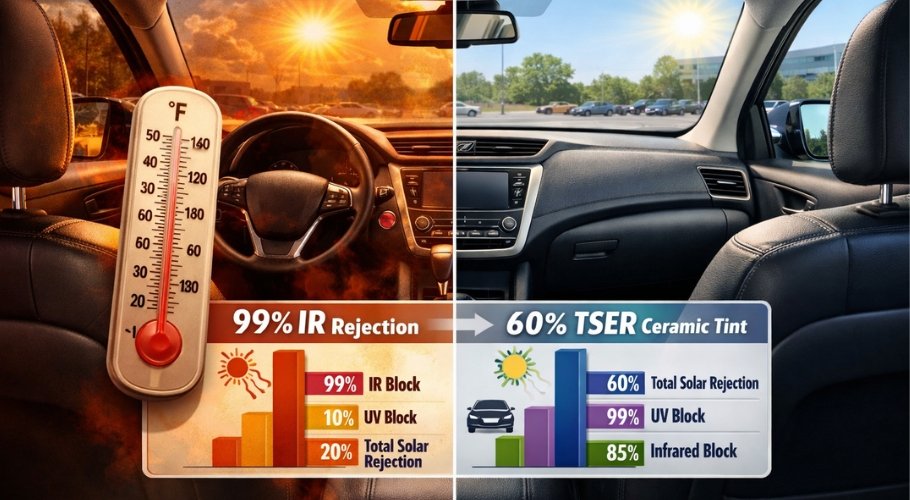
The TSER Myth: Why ‘99% IR Rejection’ Doesn’t Always Mean a Cool Car.
You’ve done your research. You asked about the specs, and the sales sheet said it right there in bold: 99% infrared rejection. You paid for a quality film. You drove off the lot expecting relief from South Jersey’s brutal July heat. And then you sat at a red light on Route 38 in Mount Holly with the sun hammering through your windshield, wondering why your car still feels like a greenhouse.
You weren’t sold a broken film. You were sold a number that — while technically accurate in a very narrow sense — doesn’t mean what most people think it means. Understanding why that gap exists is the difference between choosing a film that looks impressive on a spec sheet and one that actually makes your drive across Burlington County comfortable in August.
The Number That Looks Great but Tells Half the Story
Infrared rejection — often listed as IR Rejection or IRR on spec sheets — measures how much infrared radiation a window film blocks. On its face, that sounds like exactly what you want to know. Infrared radiation is heat radiation. A film that blocks 99% of it should mean an almost heat-free car, right?
Not quite. Here’s why.
Sunlight reaching your car windows is not made of infrared radiation alone. The solar spectrum that hits your glass every day is composed of three distinct energy types: ultraviolet light (UV), visible light, and infrared radiation. Each carries energy. Each generates heat when it passes through glass into your vehicle’s interior.
The actual breakdown is: infrared radiation accounts for roughly 53% of total solar energy. Visible light accounts for approximately 44%. Ultraviolet light makes up the remaining 3–4%. All three of these, combined, represent 100% of the solar heat your car absorbs on a South Jersey summer afternoon.
Here’s the critical math that most spec sheets don’t walk you through. If a film blocks 99% of infrared radiation, it is blocking 99% of 53% of total solar energy. That’s roughly 52% of all the heat entering your car — and the other 47%, carried by visible light, is passing through almost entirely unimpeded. Even if IR rejection is perfect, visible light alone can still turn your parked car into an oven in a Cherry Hill parking lot in July. That 99% IR figure isn’t a lie. It’s just not the whole story.
The Wavelength Problem: How “99% IR” Can Be Even Narrower Than It Sounds
There’s a second layer to this that even car owners who understand the IR/TSER distinction often miss, and it matters significantly when you’re comparing films and prices across South Jersey installers.
Infrared radiation spans a wavelength range from 780 nanometers to 2,500 nanometers. That’s the full infrared spectrum — and films that perform across the entire range deliver genuine, broad infrared heat rejection.
However, many manufacturers measure and advertise their IR rejection at a much narrower wavelength window — typically 900nm to 1,100nm. This is a portion of the near-infrared spectrum where many films happen to perform at their highest efficiency. The result is a number that is technically accurate for that specific slice of the spectrum, but dramatically overstates performance across the full infrared range.
A film rated at 99% IR rejection within the 900–1,100nm window might perform at 60–70% rejection when measured across the complete 780–2,500nm infrared spectrum. Those are very different films with very different real-world outcomes — and both might carry the same “99% IR Rejection” headline on their product sheet.
Industry professionals know to ask for full-spectrum IR data. Most consumers buying a tint job in Evesham Township or Moorestown on a Tuesday afternoon don’t know to ask the question at all.
The Number That Actually Tells You How Cool Your Car Will Be: TSER
Total Solar Energy Rejected — TSER — is the metric that genuine heat performance lives in. Where IR rejection measures one component of the solar spectrum at a potentially cherry-picked wavelength, TSER measures the complete picture: how much of all solar energy (UV + visible light + infrared, combined) is being blocked from entering your vehicle.
This is the number that predicts what your car actually feels like on Route 130 in July.
A film with a TSER of 60% is blocking 60% of all the heat the sun is trying to push through your glass — accounting for every component of the solar spectrum. A film with 99% IR rejection but a TSER of 35% is blocking only 35% of the total heat load, because visible light — the 44% component — is passing through with minimal resistance.
Here’s a real-world illustration. Two films, side by side on a spec sheet:
Film A: 97% IR Rejection / TSER 38%
Film B: 75% IR Rejection / TSER 59%
Film A’s IR headline is dramatically more impressive. But Film B is rejecting significantly more total heat — the thing that actually determines whether your car is comfortable after sitting in a Marlton parking lot for two hours. In a South Jersey summer, Film B wins the test that matters. Film A wins the marketing battle.
Most window films on the market today have TSER values ranging from 30% to 80%. Premium ceramic films — the category that performs genuinely across the full spectrum without relying on heavy tinting or metallic coatings — typically achieve TSER values in the 50–66% range while maintaining high visible light transmission. That combination of broad-spectrum heat rejection without significant darkening is what separates them from basic dyed films, which often achieve comparable TSER numbers only by blocking visible light heavily — making the car darker and cooler but at the cost of visibility and, in some cases, legal compliance with New Jersey’s tint laws.
Why This Matters More in South Jersey Than Almost Anywhere
South Jersey’s summer climate makes accurate film specification genuinely important — not just a matter of comfort preference.
Burlington County and the surrounding area sits inland from the coast, which means no Atlantic sea breeze moderates the afternoon heat the way it does in Shore communities. Summer heat index readings in this region regularly push past 99°F during peak weeks, and the combination of high humidity and direct solar radiation creates conditions where vehicle interiors can reach temperatures well above 130°F when parked in direct sunlight.
In those conditions, the difference between a film with TSER 38% and one with TSER 60% isn’t an abstract performance statistic. It’s a temperature difference of 20°F or more inside a parked car. It’s the difference between a car that’s uncomfortable and one that’s actively dangerous for children, pets, and people with heat sensitivity left in it briefly.
South Jersey also has a significant commuter vehicle population — drivers making daily runs through Burlington, Cinnaminson, Medford, and Voorhees, spending an hour or more in direct sun each way during peak summer months. Cumulative heat exposure and cumulative UV exposure across those hours makes the real-world performance of a film something you live with every day, not an abstract specification.
Visible Light: The Invisible Driver of Interior Heat
One of the most counterintuitive things about window film performance is how much heat visible light actually generates. Most drivers associate heat with the warm, reddish light of sunset or the glowing heat of an infrared lamp. But the bright, white noontime sun that floods through your windshield on Route 295 is carrying 44% of its energy as visible light — and that energy converts to heat when it hits your dashboard, seats, and interior surfaces.
Films that rely primarily on blocking visible light to achieve their TSER numbers are trading one problem (heat) for another (darkness). A very dark 15% VLT film will have an impressive TSER number, but it achieves that by blocking light you might want — and in New Jersey, front windows must remain untinted entirely, meaning the front glass can’t be darkened regardless of specification.
This is precisely where spectrally selective ceramic films earn their value. By targeting the infrared spectrum with nano-ceramic particle engineering — rather than relying on darkness or metallic reflectivity to boost TSER — they achieve high total solar energy rejection while maintaining high visible light transmission. A ceramic film at 70% VLT (barely perceptible darkening) can still achieve TSER values in the 55–65% range by selectively blocking the infrared wavelengths that contribute most to heat gain.
The result is a car that stays meaningfully cooler, remains well-lit inside, and doesn’t create the “darkened room” feeling that heavy tinting produces — while staying fully compliant with New Jersey’s front window regulations.
What to Ask Before You Commit to an Installation in South Jersey
Armed with this understanding, the conversation you have with an installer before booking changes considerably. Here are the specific questions that separate a film that will genuinely perform from one that will look great on paper and disappoint in practice:
Ask for the TSER value, not just the IR rejection number. Any reputable installer can provide full spec sheets for the films they carry. TSER is the honest comparison metric.
Ask whether IR rejection is measured across the full 780–2,500nm spectrum, or only at a narrower range like 900–1,100nm. The answer tells you whether the advertised IR number reflects real-world performance or a best-case slice of the spectrum.
Compare films with matching VLT values. A darker film will almost always show higher TSER than a lighter film from the same product line. To make an honest comparison between two different film categories — say, a dyed film versus a ceramic film — look at their TSER values at comparable VLT ratings. That’s an apples-to-apples test.
Ask about performance longevity, not just initial numbers. Dyed films degrade under UV exposure. A film that tests at TSER 45% when new may perform at TSER 30% after two South Jersey summers. Ceramic films maintain their performance ratings over time with minimal degradation, which matters significantly over a multi-year ownership period.
To get a straightforward, spec-honest assessment of which film will actually deliver on heat performance for your specific vehicle and daily driving conditions in South Jersey, consider speaking with a local window film specialist who’s willing to walk through full TSER data — not just IR headlines — before recommending a product.
The Bottom Line: Read Past the Big Number
“99% IR rejection” is a compelling headline. It’s also a number that — without context — tells you very little about how cool your car will actually be parked outside a Burlington County office building in August.
The full solar spectrum is what heats your vehicle. TSER measures the full solar spectrum. IR rejection measures a portion of it — and in some cases, only a narrow slice of that portion, measured at the wavelength range where a particular film performs at its peak.
That doesn’t mean IR rejection is a useless metric. It’s a useful data point when you understand what it represents. But it’s a starting point, not a conclusion — and in South Jersey summers, the film that delivers on TSER is the one that delivers on comfort.
Know what you’re buying. Ask for the full picture. The numbers are all available for the asking — from any installer who knows their products well enough to be worth trusting.