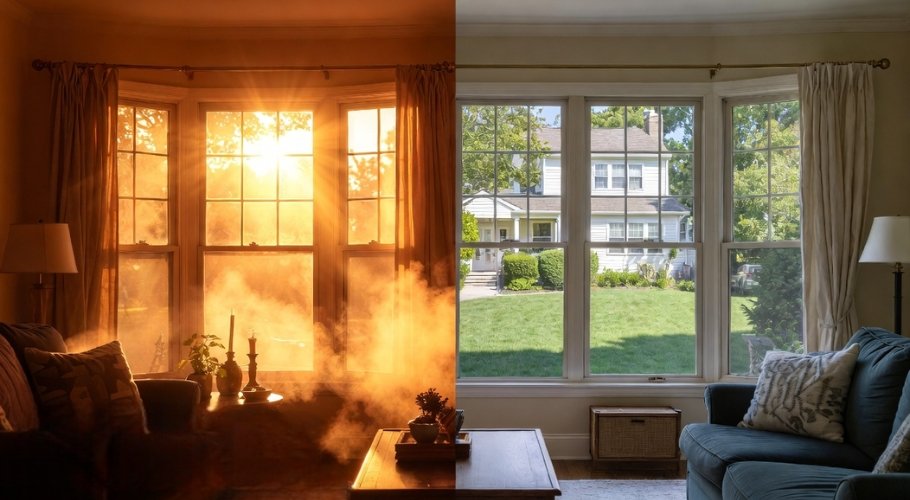
Beating the Burlington Humidity: Why Ceramic Film is a Must for Garden State Summers.
By mid-July, Burlington, NJ isn’t just hot — it’s aggressively, exhaustingly hot. State climatological data has recorded heat index readings pushing past 99°F in Burlington County, with inland areas absorbing solar radiation that coastal breezes never reach. Combine those temperatures with humidity that keeps dew points hovering in the mid-70s, and sitting near a window in your home or car doesn’t just feel uncomfortable — it feels like a losing battle against the sun.
If you’ve been fighting that battle with a ceiling fan and some closed blinds, you’re addressing the symptom, not the source. The heat you’re feeling in July isn’t coming through your walls. It’s coming through your glass. And the type of film on that glass — or the absence of any film at all — makes a significant difference in how much of the Garden State summer actually follows you indoors.
Why Burlington’s Summer Climate Is Harder Than It Looks on Paper
Burlington sits in a geographic position that makes summer particularly punishing. Inland from the coast, the city doesn’t benefit from the sea breeze that moderates temperatures in places like Long Beach Island or Cape May. The Delaware River valley can trap warm, moist air, turning afternoon heat events into prolonged, heavy stretches of humidity that linger well into the evening.
The New Jersey Office of the State Climatologist has documented Moorestown — just minutes from Burlington — recording temperatures as high as 99°F during summer heat waves, with statewide data showing Burlington County among the highest heat-index readings in the region. The state’s own emergency management data confirms that New Jersey is warming faster than the national average, with summer heat waves becoming longer and more frequent. Since 1895, annual temperatures across the state have risen 3.5°F — and projections from NJDEP suggest an additional 4 to 5.7°F of warming by 2050.
That trajectory matters for Burlington homeowners and businesses right now, because the glass in most residential and commercial buildings was designed for a climate that no longer exists.
The Physics of What’s Happening at Your Window
Sunlight reaches your window carrying three types of energy: ultraviolet (UV) light, visible light, and infrared radiation (IR). Each behaves differently, and each causes different problems.
UV light, while only about 5% of solar energy, is responsible for fading furniture, flooring, and upholstery. It also drives cumulative skin exposure risk for people sitting near windows for hours each day — in a home office, at a kitchen table, or behind the wheel of a car.
Visible light is what allows you to see, but it also carries heat. It’s roughly 44% of the energy reaching your glass.
Infrared radiation is the silent culprit behind that “microwave feeling” you get near a sun-drenched window. Near-infrared energy alone accounts for approximately 53% of total solar heat gain. You can’t see it, you can’t block it with curtains (which simply absorb it and re-radiate it inward), and standard glass does almost nothing to stop it.
Factory-installed privacy glass in vehicles typically rejects only 15 to 25% of heat. Standard single-pane residential glass performs similarly. The result, in Burlington’s summer conditions, is glass that functions more like a heat amplifier than a barrier.
What Ceramic Film Actually Does — and Why It Outperforms Everything Else
This is where ceramic window film separates itself from every other option in the market.
Ceramic film is built around nano-ceramic particles — microscopic engineered materials that target the infrared spectrum specifically. Unlike dyed films, which simply darken glass and absorb some energy, or metallic films, which reflect light but interfere with electronics and signals, ceramic technology operates at the molecular level to intercept heat-carrying wavelengths before they pass through your glass.
The performance numbers tell the story clearly. High-performance ceramic films reject between 60 and 80% of infrared radiation. Premium nano-ceramic films push those numbers further — with some lab-tested products achieving 85 to 96% IR rejection across the 780–2,500 nanometer range. Total Solar Energy Rejected (TSER) values for quality ceramic films regularly fall in the 50–66% range, meaning more than half of all solar energy is turned away at the glass before it becomes interior heat.
For Burlington residents dealing with July heat indices above 99°F, that kind of rejection rate isn’t a luxury — it’s a meaningful change in how a space feels to live and work in.
There’s another dimension that matters specifically for the humid conditions Burlington experiences. Humidity makes heat more physiologically stressful because it limits the body’s ability to cool itself through perspiration. When radiant heat from window glass is layered on top of high ambient humidity, the perceived discomfort intensifies significantly. Reducing infrared gain through ceramic film doesn’t just lower the measured interior temperature — it reduces the radiant load on occupants directly, which in humid conditions makes a disproportionately large difference in how comfortable a space actually feels.
Ceramic vs. Dyed and Carbon Films: The Gap Is Wider Than Most Buyers Expect
When Burlington homeowners or car owners shop for window film, they often encounter price tiers without clear explanations of why the difference exists. Here’s what the data actually shows:
Dyed films represent the entry-level category. They’re inexpensive, they darken glass visually, and they offer modest UV protection — typically around 96% UV blocking. Their infrared heat rejection is weak. They fade and degrade relatively quickly, especially under the kind of relentless summer UV exposure Burlington sees from June through September.
Carbon films perform better. They offer 40 to 50% infrared blocking and better color stability than dyed films. They don’t interfere with electronics, which matters for modern vehicles loaded with GPS, mobile connectivity, and driver-assist systems. But their performance degrades over time — studies in the installation community show a 10 to 15% reduction in performance after three years of daily sun exposure.
Ceramic films operate in a different category. They consistently maintain 95 to 99% of their heat rejection capability over five years or more. They don’t purple, bubble, or lose adhesion under the heat cycling that Burlington summers impose. And critically, because their heat rejection is achieved through particle engineering rather than film darkness, they can deliver substantial infrared blocking even at lighter VLT levels — which means you can have meaningful heat protection without significantly altering the appearance of your windows or running into NJ legal compliance issues on your vehicle.
For homeowners, this means rooms that stay cooler with less air conditioning load. Research supports a 10 to 15% reduction in AC energy consumption with high-TSER window films, which — given New Jersey’s energy costs — represents real savings across a full cooling season.
Residential and Commercial Applications in Burlington: What to Prioritize
In residential applications across Burlington, the most impactful placements are typically south- and west-facing windows. These orientations receive direct afternoon sun during the peak heat hours of the day — typically 1 PM through 6 PM — when Burlington’s summer temperatures are at their highest and humidity is at its most oppressive.
Living rooms and home offices with large west-facing glass are often the first rooms that become unusable on summer afternoons without intervention. Ceramic film on these windows can reduce interior temperatures measurably, protect flooring and furniture from UV degradation, and eliminate the glare that makes screen-based work difficult during afternoon hours.
For businesses in Burlington — retail, professional offices, restaurants, and service-oriented spaces — the case is even stronger. Uncomfortable interior environments affect customer dwell time and employee productivity. A commercial space running its HVAC at full capacity to compensate for radiant heat gain through glass is also running an unnecessarily high utility bill. Ceramic film addresses both problems at the point of entry — the glass itself.
For vehicles, ceramic film is increasingly the standard for anyone spending significant time in their car during Burlington’s summer months. The difference in cabin temperature between a vehicle with no film and one with high-performance ceramic can exceed 25 to 30°F in a parked car — which is not a minor comfort improvement. It’s also a health and safety consideration for children, pets, and anyone with heat sensitivity.
The Long-Term Investment Case for Burlington Property Owners
One of the most important reframes for Burlington property owners considering ceramic window film is the question of time horizon. Dyed or basic tinted films may be cheaper upfront, but they require replacement within a few years and deliver diminishing performance as they degrade. Ceramic films carry meaningful upfront cost that is offset by a service life that routinely exceeds a decade — with no significant performance loss.
During that lifespan, they’re continuously reducing cooling costs, protecting interior furnishings from UV damage (which compounds in value for high-quality flooring, furniture, and artwork), and maintaining the comfort levels that make a home or business genuinely livable through Garden State summers.
When you map that against Burlington’s increasingly intense heat profile and the city’s position in a county that regularly appears at the top of NJ’s summer heat-index charts, the calculus becomes straightforward. The summers are getting harder. The glass in most buildings wasn’t built for what those summers are becoming. Ceramic film is one of the most cost-effective interventions available for that problem.
To explore which ceramic film specifications make sense for your specific home, vehicle, or commercial space in Burlington, consider speaking with a local window film specialist who understands both the regional climate and the performance differences between film categories. The right specification matters as much as the decision to film at all.
Conclusion
Burlington, NJ summers are no longer the mild, manageable stretch they once were. Inland heat, Delaware Valley humidity, and a documented warming trend have made the glass in homes, businesses, and vehicles a legitimate comfort and energy problem. Ceramic window film — with its nano-engineered infrared rejection, long-term performance stability, and ability to work without heavy tinting — is the most technically capable answer to that problem available today.
The sun isn’t negotiating. The humidity isn’t going anywhere. But what comes through your glass is something you can actually control.